

Over the next few weeks, I’ll share a short node each Wednesday, exploring one concept in Systems Thinking. I’m calling this series The Pattern Catalogue. It's part of my ongoing practice of learning in public and sharing a bit of knowledge.

An antidote to fragmentation
Everything is made up of systems. I can spot them everywhere: in the garden, the apiary, at work, even in the household.
By learning the language of systems, we start to notice the connections that were invisible before. It becomes another lens for making sense of a seemingly orderless world.
Life, all too often, is defined by a feeling of separation: a bunch of shards, randomly spread out over the floor after breaking a vase. I want to explore the antidote to this Cognitive Fragmentation.
The place where we live, our work, the nature that surrounds us, our hobbies, our relationships, finances, governments, food from the supermarket... all seemingly isolated pieces. How do we reconnect them?
In order to repair that vase, we need to define the mode that stimulates separation, and the other mode that provides the glue.
The Map of the Singular: Topic Mode
One mode is what I’ll call the Topic Mode.
To explain this mode, we’ll have to look outside, at the activities involving nature in its broadest sense.
The Topic Mode writers are the classical garden writers. The vegetable growers providing how-to manuals, the beekeepers focusing strictly on apicultural methods. They offer a deep and necessary knowledge of a specific domain; hard-won technical skills, practical clarity. The focus of their work is the activity itself. The topic is the garden. The topic is the apiary.
This mode gives us mastery over a fragment: how to graft, how to catch a swarm, how to read the soil.
But in a world already suffering from fragmentation, the Topic Mode has a subtle risk: it can reinforce the idea that life is made of separate compartments, of specialisms.
It took me some time to understand that there is another mode. One that doesn’t replace the first, but changes the sequence.
Expanding the View: Pattern Mode
I call this second mode the Pattern Mode. It treats the great outdoors not as a separate space, but as an organic pattern recognition device.
Nature, then, becomes our key for unlocking another way of seeing. It becomes our guide to noticing the larger systems. And therefore we can start to connect the singular into a coherent patchwork.
The garden stops being a place where we “simply” grow food. It becomes a place where we observe how growth actually happens.
Pattern Mode teaches us the impact of edges (where two systems meet, life is densest). It teaches us that design shapes behavior. It teaches us that systems heal through feedback.
We stop seeing “the garden” and “the economy” as separate. We start to see that the laws governing a beehive facing winter are not so different from the laws governing a business facing a recession. We use the garden as a compass to navigate the fragmentation of the modern world.
The singular topic remains important. But we begin to zoom out. The garden stops being only a place we do things. It becomes a place that teaches us how things connect.
The Grammar of the Pattern
To understand why this shift is so difficult, we have to look at the grammar of our thinking. It means distinguishing between the concepts of analysis and synthesis.
Analysis is the art of taking things apart.
It explains the parts so we can understand the mechanism.
Synthesis is the art of putting things back into context.
It explains the whole so we can understand the role the part is playing.
Analysis gives us specific knowledge. It tells us how a clock works, or the mechanics of how a bee flies.
Synthesis gives us meaning. It tells us what the clock is for in the room, and even more, how time shapes our days. It tells us how the individual bee is part of a larger superorganism; the colony. And that those bees play an important function in the bigger ecosystem they are part of.
Both play an important role. You can’t synthesize without some knowledge of the individual parts.
The problem isn’t analysis; the problem is analysis without reconnecting it back to the whole.
Hitting the Iceberg
Now we’re starting to enter the terrain of thinking in systems.
The difference between our common perception of the world and the invisible pattern that stitches everything together can be visualized as an iceberg.
Events are the visible tip, floating in the vast openness of the sea. The isolated artifact. However, there is an entire invisible world below the waterline. These are the patterns over time, the underlying structures, and the mental models that hold the system in place.
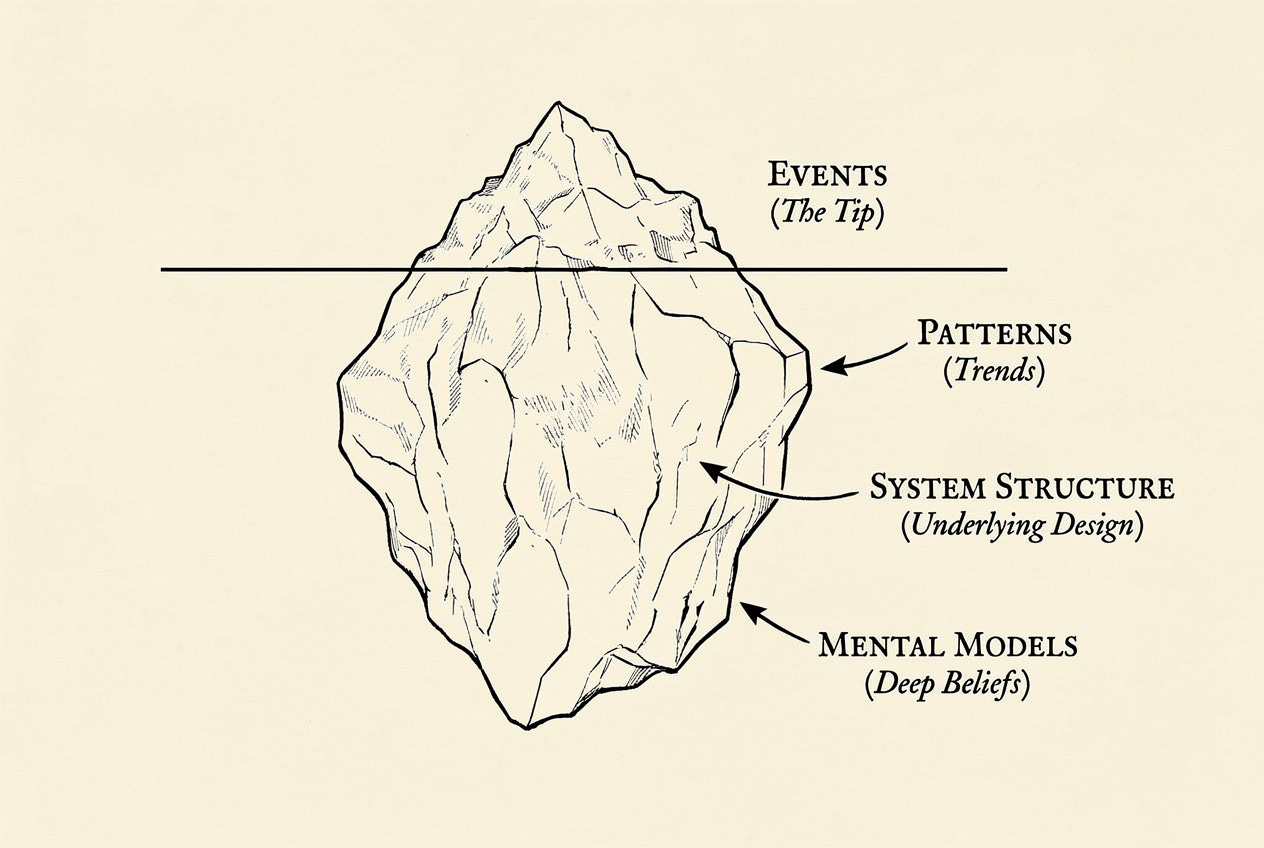
The Topic Mode is part of the tip: the realm of events. It sees the noun: the weed, the swarming bees, the angry email. Its instinct is to react. To fix the immediate problem. Pull the weed. Cull the swarming cells. Send the reply.
The Pattern Mode is the seemingly non-visible. It looks for the trend and the structure that generates the trend. It doesn’t only want to fix the event; it wants to understand the design flaw that keeps producing the problem in the first place.
If we only use analysis, we might see a stinging insect.
If we add synthesis, and thus dive down the iceberg, we see a crucial pollinator for many flowering plants, a small agent in the reproductive economy of the landscape.
A Practice: Switching the Sequence
If you want to move from Topic Mode to Pattern Mode, try this small shift the next time you encounter a problem. Stop staring at the event, and start looking for the system structure.
Take the image of an ‘unwanted weed’ in the garden.
In Topic Mode we might say: “This is a dandelion. It is a weed. It is ruining my lawn. I need to dig it out.”
In Pattern Mode we decide to take a step back. We ask ourselves: “What system is this part of? A soil system. What is the whole doing? It is stressed and compacted. What role might this plant play? It has a deep taproot. It is breaking compaction and mining minerals from below.”
We gain a new insight. The dandelion isn’t the problem. The compaction is. The “weed” is actually part of a larger process in the garden. And it’s the system’s attempt to fix itself.
Re-entering the World
We can apply this way of thinking to every aspect of our lives. First we have to recognize the patterns, then we can start to synthesize.
We start to notice the little systems inhabiting our ordinary routines: the commute, the supermarket supply chain, the meeting culture, the way incentives shape behavior, the hidden costs we export and call “efficiency.”
We stop seeing these as isolated, chaotic events and start seeing them as interconnected relationships. We begin to understand the role we’re playing inside them. We start to see the “why”.
That perspective doesn’t magically solve everything, but it replaces the anxiety of fragmentation with a newfound orientation.
We can start to navigate the entire iceberg. Not only the tip.
And that, to me, is the real use of using systems as a way to rethink our thinking.
Not escape. Not décor. Not a separate shard.
But a map.
Next in the Catalogue: Entry 002 Holism. Now that we have separated the part from the whole, how do we move between them? We will explore the ability to navigate levels of context without losing the patch you started from.
A Note on the Commons I am keeping The Perennial Workshop open to everyone because I believe we all need these tools to rethink our thinking. If these writings offer you insight and value, consider becoming a paid subscriber to support the workshop.
The way you described Topic and Pattern Mode reminded me strongly of the first pages of a book I started: The Geography of Thought by Richard Nisbett. He attempts to explain the differences in thought between the western and eastern cultures, starting with Ancient Greece (object attributes, abstractions, logic, debate) and Ancient China (events are related to one another, harmony, interconnectivity, contradictions). Linear and circular views.
On the topic of identifying where 2 systems meet, I imagine it would be necessary to first see both systems in Pattern Mode and then try to see how they affect each other. How do you think it would be clear to see the impact of the edges of 2 specific systems, and not a third?
Out of curiosity, how did you create the diagram of the iceberg? It brings such clarity to the essay.
This is so lovely, and accurate. Autistics do this kind of processing naturally. But there is one qualm i’ll raise about the privilege it takes to have the mental resources to come to any reasonable conclusions after observation, when one is being mined for labor under the current global oligarchical system. I’m an artist, i've got time. But the majority of the working class can’t find time to sleep, not to mention observe the intricacies of their condition. This is excellent information to have after some kind of real world upending that gives us the cognitive resources required to put this to work. Otherwise what’s the point?