
The Third Nest
On hornets, disturbance, and finding balance

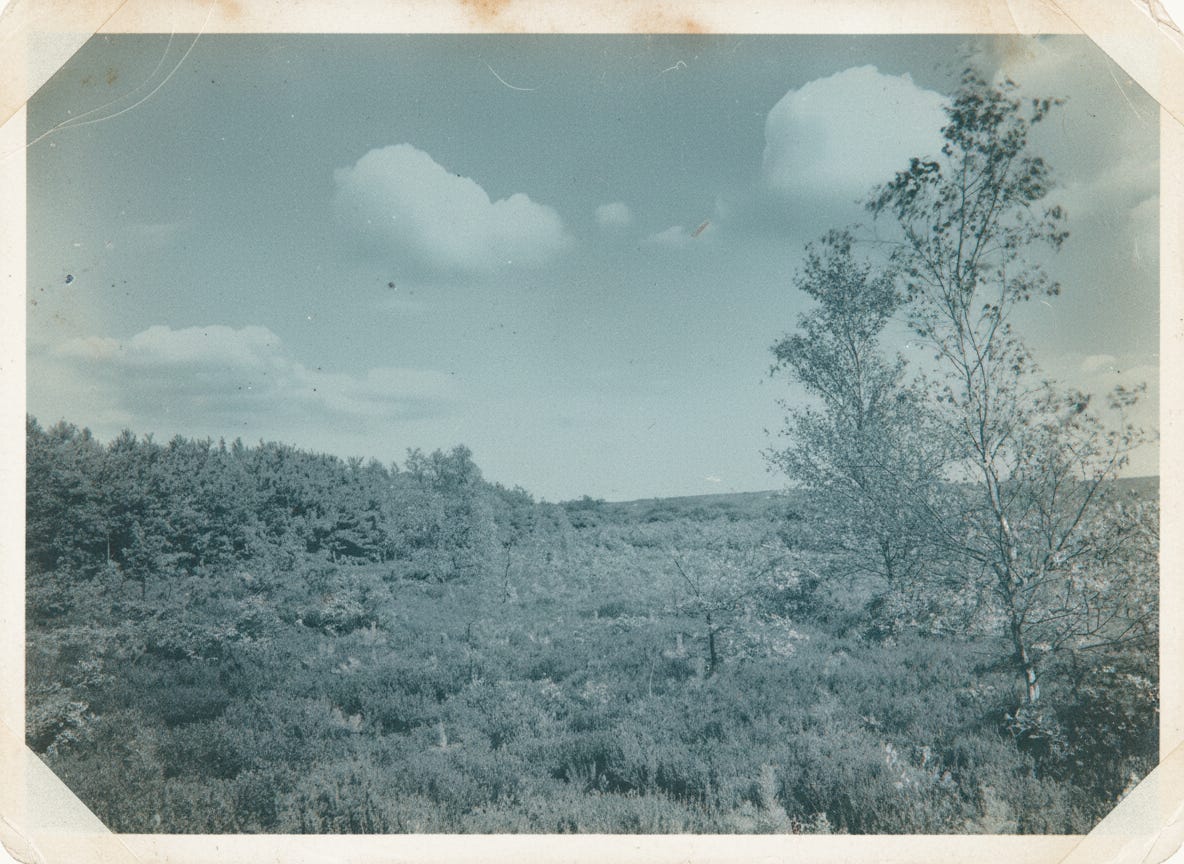
We live at the end of a dead-end street. The narrow asphalt lane turns into an even narrower gravel pathway, winding its way between a soggy patch of poplar and willow. At the end of that meadow, the Gete River meanders patiently along.
Griet and I are walking alongside the river, using a verge of rough grassland as our road. Autumn is setting in and that feeling of change is all around the landscape. Rain boots sticking in the mud and that annoying feeling when socks keep slipping down inside them.
We’re on a mission, trying to spot the nest of Vespa velutina — the Asian hornet. This year we’ve already tracked down two nests within 500 meters of the apiary. The huge, spherical nests — a sort of papier-mâché art installation — dangling high from the top of a tree. They sway with the crown, maybe 25 meters or so above the ground, following the rhythm of the winds. A truly ingenious architecture and a proof of the genuine inventiveness of nature.
But those hornets are invasive. And they keep bullying the bees. They linger around the hives, snapping the returning workers mid-air. At peak moments, five or six of them hovered in front of each hive. The bees have no defense mechanism (yet) for that exotic predator. So for now we have to lend a hand. And we had the nests removed.
Alas, it turns out there must still be a third nest. The hornets are still there — the neighbours’ blooming ivy even buzzing with plenty of them. Good thing is that the trees are losing their leaves, making the nests easier to spot. So we keep patrolling.
Our search leads us along stretches I don’t usually walk, and the slower pace makes me notice other transformations happening here. A few years ago, they cleared the old poplar plantation that used to occupy this space. Now this area is becoming part of a bigger picture: a naturally established piece of forest, part of the Gete Valley. Instead of replanting with saplings, the decision was made to let nature establish itself. See what’s sprouting up, and what’s already there, in that infinite seed bank called earth.
It’s an interesting spot to watch succession unfold — how an ecosystem reorganizes itself after disturbance.
The cleared forest lay barren last year, mainly occupied by fast-growing pioneer species: nettles, brambles, grasses. Now it’s turning into a mosaic of young trees, shrubs and herbs — almost a native savanna.
Of course, there are the young poplar shoots, reclaiming their piece of territory. But also elders, with their distinguishable bark. And willow. Oak. Hawthorn. Beneath that: broad-leaved grasses I cannot name, shiny drops of water pearling on the flat surfaces. Hogweeds, carrying heavy heads of seed, weeping in the wind. Patches of comfrey, the biomass providers, bringing layers of mulch to the table in the form of their decaying leaves.
Our improvised trample path next to the river and through the soon-to-become forest leads to a huge clearing: an open meadow, surrounded by the quiet view of the valley. The sky is covered with a whimsical wall of clouds. Magenta. Far in the back: a tight, horizontal opening, stretching along the horizon. The setting sun - warm orange, yellow hue — glowing through that cloudy window as we return home.
Nature seems to be most resilient and most diverse when we let her do her thing. Give her time to adapt and let natural emergence be part of the process. Predation is a disturbance too — just like the cleared poplar stand. If we steward for strength instead of control, the system can learn its way toward balance.
Maybe I have to reconsider my approach towards the hornets, too. I suppose they won’t be leaving soon. And even though they predate on my bees, I still think they are fascinating creatures.
The bees, then, will have to find a coping mechanism for fighting those hornets themselves. Establish a balance once again. This will take time, but we’ll have to give them the chance to work something out. This doesn’t mean leaving them to their own devices. It means stewarding the bees towards resilience. Giving them the right conditions (i.e., make sure the colonies are strong and healthy). And of course, if the hornet pressure crosses a certain threshold, I’ll still be lending them a hand.
In the end, that’s the only sustainable way for a system to work — finding its own equilibrium, adjusting to what comes, standing on its own roots.
These field notes are part of The Perennial Workshop — an experiment in observing, learning, and tending the systems we live in. If you’d like to walk along, subscribe or share the path with someone curious.