

These pages are written in the present, one at a time. But they only add up to something if, now and then, I stop to look back and trace the bigger picture. The theme that kept returning these past months was growth. Growth in all its incarnations, set against that common, modern definition of growth as something linear and infinite.
1.
The heat wave. Many days above 30ºC. Nights not cooling down.
Then: the thunderstorm. The amplified sound of clattering rain on the roof. The one we share with the birds. It is a living house after all.
And through the open windows, the rain flows into the cracks between the pine floorboards.
We’ve been living here for more than 15 years now. The garden, the house, never really finished. There’s always something to repair, always some project waiting. I guess that’s the cost of keeping things alive.
Are we already part of the place or still only visitors?
And: am I part of the map or merely the cartographer?
The visitor: the one who lives in a place without being part of it. Doesn’t leave a trace. The house, the garden, the surroundings...mere commodities.
The inhabitant dweller: dwells in their own traces. Here to stay and add a layer in the thick book of history of this specific place. And to see the shaping of the place happen through the stains of time and the stories that survived.
The place starts to grow on us and that place then, grows into meaning.
2.
The next morning: rising early to get some writing done. The old house, a heat trap. So I open all windows and doors. A warm breath entering the premises.
And then: My attempt at drawing a map of the past season, in the garden and on these pages.
Spring: that season of perpetual growth. And growth was on my mind. Growing this newsletter, yes. But not really in a quantitative way.
I guess that mindset already defines part of the dweller’s realm.
The visitor holds the mechanic worldview. Nature as a device we can take apart, rearrange and reassemble to our likings. Every place interchangeable. Come and go. And everything, then, becomes seemingly predictable: order, growth, future.
And then there is the gardener, who understands that nature has no chaos or true order. We’re tending something living, something always in motion. Adapting and working on a terrain where change is part of the system.
3.
Maybe 9 am. The wet grass still full and green and setting seeds. And lots of white clover in bloom. The humidity. The gaps in the forest and the sun already peeking through.
Into the vegetable garden.
The nightly rain shower plus the heat and my own compost mix. The perfect seed bed for pioneer weeds. Nettle, yarrow, dandelion, even willow. All flourishing, claiming their spot.
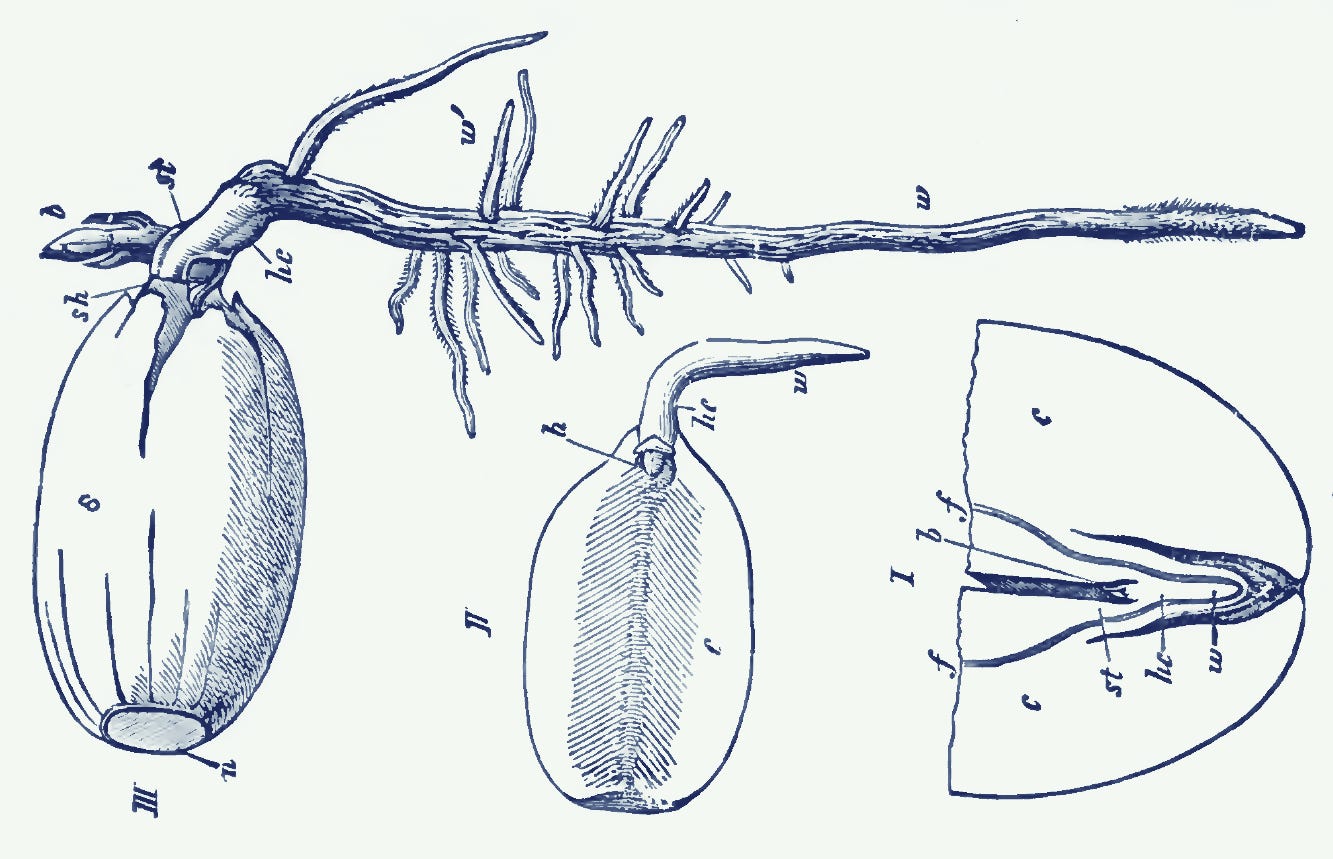
We could learn from the life of seeds. Their patience. Until the right conditions are there. And then it emerges. Growth at plant speed. Both above and underground. Into the dark soil and up to the bright sky. Shadows and light.
All plants, Maeterlinck wrote, have the magnificent ambition to overrun and conquer the surface of the globe by endlessly multiplying.
The garden is neither completely tamed, nor completely wild. It is a sort of co-authorship. Sometimes the garden decides and sometimes it is me taking the decisions.
And in the vegetable garden, it’s me taking the lead. So I take the old, trusty hoe and start weeding.
4.
High noon. The sun singled out in the midst of a sea of blue. No clouds.
The background buzzing from the apiary getting louder and louder. A frantic sound of activity echoing from the hives into the garden.
The almost exponential growth of a colony, a reinforcing feedback loop, until they reach a threshold. The hive bursting at the seams. Then: the swarm, the release.
The old queen leaves, together with probably half of the colony. In the hive a new queen-daughter is born. She inherits the house, the place, the memory, a bit of old comb.
The system resets to a scale it can maintain. And then it begins all over again; the infinite cycle.
But no swarm today. Many young bees in their orientation flights and rush hour on the bee highway above my head.
5.
Later that day. A bit of work to pay some bills. Between the garden and the writing and the university work, I am trying to set up this micro business. A little video studio that makes content that aligns with my values: a few good clients, sustainable content, well crafted.
Being a freelancer in 2026: high competition, AI-slop and cost-cutting. So there are essentially two options: scale up and compete aggressively, or lower standards and work cheaper. That’s what I call the Great Drift.
But I neither want to lower my standards, nor do I want to grow to a size that is unsustainable. Then I’d rather quit. Same with these writings.
And if I treat it as an experiment, failure is simply part of the process.
6.
Then: the sun is finally descending the horizon. Long, moving shadows. Tree silhouettes drawn in dark-black chalk on the floor.
Maybe suckering the tomatoes in the greenhouse real quick.
That old greenhouse that we rebuilt this year. The same mechanism that trapped heat a hundred years ago. Glass, patience and the art of the trap, that’s all that’s needed.
The idea that growing is embedded in the fertile realms of the past, the knowledge and traditions. All those things that are part of the material, the labor and love for the work. The long now. The Miel heirloom tomato inherited from an old neighbor.
7.
That moment when the air starts moving again. Colors shifting hue. In the little food-forest orchard, in the half-shade, underneath the apples and the pears: blackcurrants, redcurrants, gooseberries. Dangling ripe fruits. Ready to harvest. The slow, layered growth of the canopy and the understory.
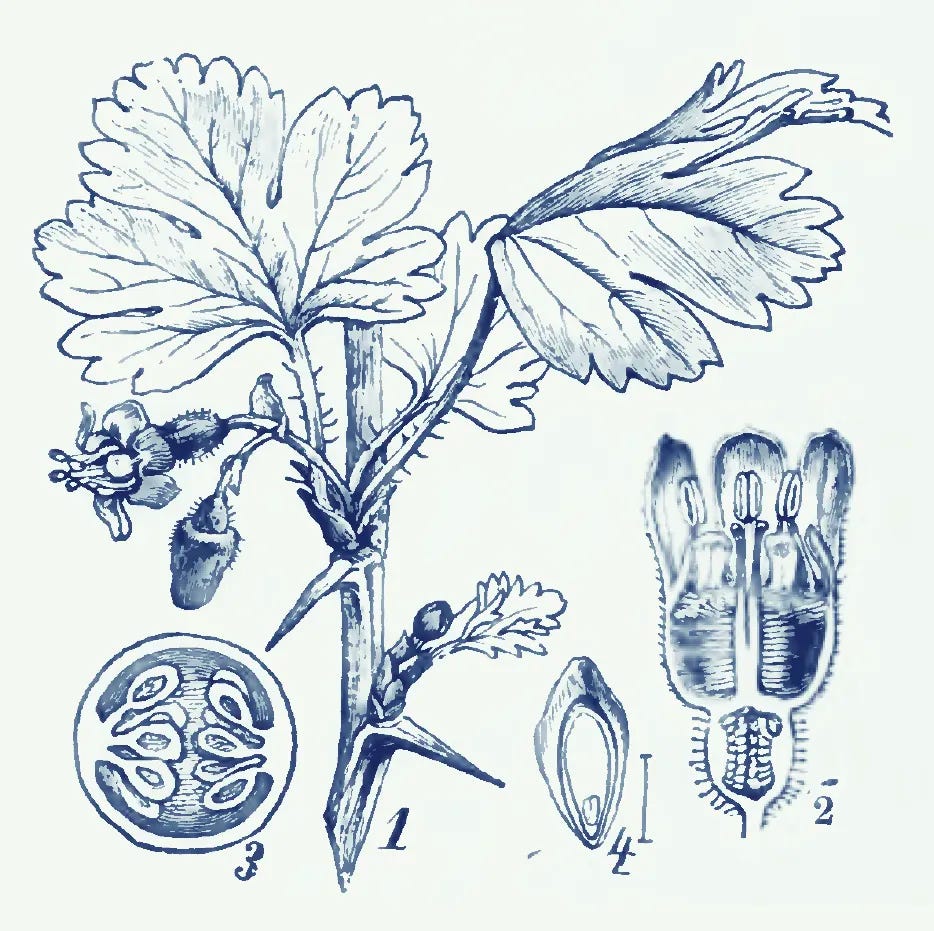
I pick a few berries and let the chickens do some harvesting, too. They happily queue for the buffet, the high doses of vitamin C.
Light fades into twilight.
And then: the large-flowered evening-primrose opening its flowers in real time.
I could easily witness this every day and not get tired of it. Slow growth, slow wisdom. The cycling of the days and the seasons.
I think that’s why gardeners are philosophers.
8.
End of day. Stowing away the garden tools.
In the barn: that huge pile of poplar logs waiting to be processed.
It’s interesting to see how the wood shifts colors as it dries. From fully green and dark haze fading into a brownish grey texture.
And then there are the tree rings.
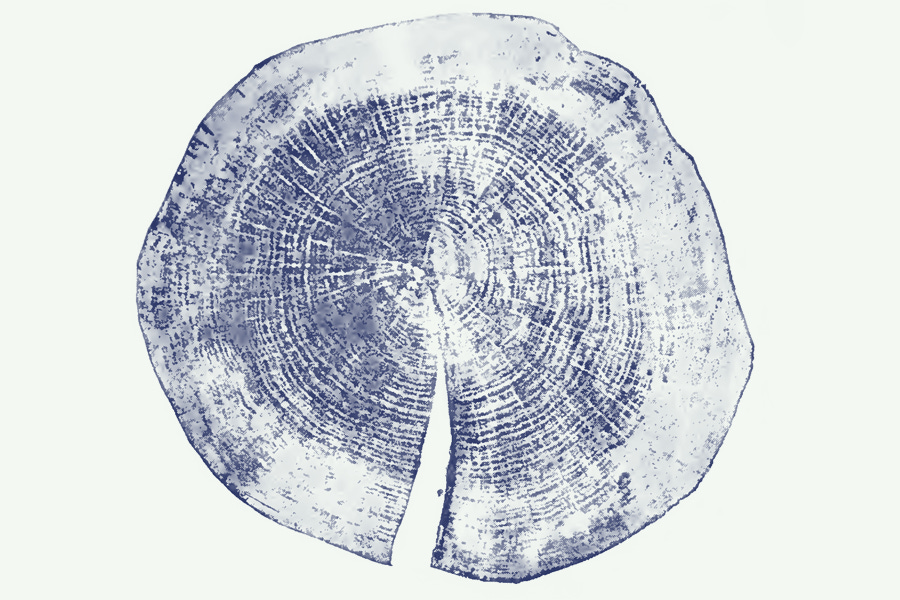
We can learn to read the tree by studying the width, color, and symmetry of the rings. Determine tree age, and the weather conditions of any given year. A record of what used to be here: the wet years, the lean years, the cold.
Wide Rings: optimal growing conditions, plenty of rain and sunlight.
Narrow Rings: Stress or harsh conditions, severe drought, cold, or lack of nutrients.
And every single annual ring is divided into two distinct zones that show the shift in seasons: earlywood and latewood. And in winter: no growth at all. Only dormancy.
I count about 17 rings on a poplar log. They were just planted when we started living here, some 15 years ago. That’s 15 years of watching that tree grow. Now it made room for the oaks and wild cherries underneath.
A summer’s work for a winter’s night.
But all of this work can wait. Tomorrow.
9.
The comfort of the sofa. Windows wide open again. A faint waxing crescent moon entering the room.
Leafing through Plato’s Philebus. The main question of the work: what is the good life? Is it a life of intellect, devoted to knowledge and insight or a life aimed at joy and pleasure?
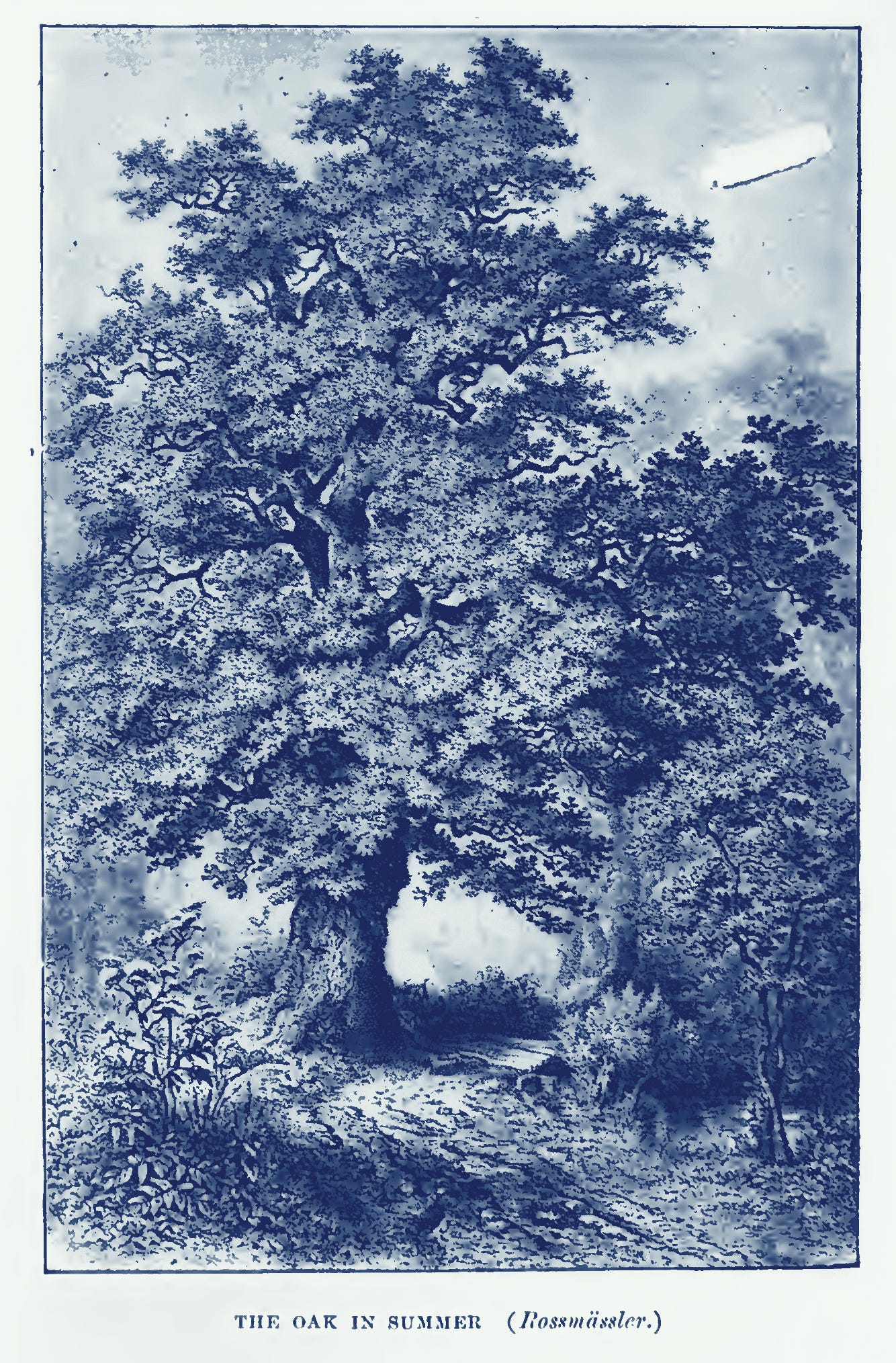
In a 1897 edition I found online, the editor compares the work to a gnarled and knotted old oak-tree abounding in unexpected humps and shoots, adding that it still contains much sound timber.
Which, I guess, is another way of saying that the work is not straightforward. Rather it’s a collection of diverse observations and dialogues, with seemingly no direct connections.
But Plato also seeds an idea: the existence of both: limits and limitlessness. The finite and the infinite.
And out of that, over the centuries, emerged our notion of how the world works. One thing against the other.
Light against shadow. Inside against outside. Order against entropy.
However, that is a faulty read of Plato. Plato’s exact words contain nuance:
The first is, I say, infinity; the second is finitude; from these two arises the third, which is a mixed and completed existence; the fourth, finally, is the cause of this mixture, and the generation to which it gives rise.
How we live, and how we grow: not one singular far end of a spectrum, a dualism, but somewhere in between. And we can be conscious about it: the limits we choose.
Plato came to the same conclusion regarding the good life: neither only pleasure, nor only knowledge, but both.
10.
Standing outside in a landscape turned dark and black, waiting for the ducks to finish muddling around, before I close the pen.
And me, trying to reconnect the stars.
I have an intuitive view of the whole of these dots, these faint points like glow worms up on the firmament, which we trace back in our own minds to a map of reality.
A reality that has been mapped over and over through ancient civilizations until now, who labeled the stars and used them to navigate. It is part of that old escapade of trying to climb out of the fur of the animal to see what is outside.
To catch a glimpse of the bigger picture.
The star-map, like the rings in the poplar log, is drawn from the inside.
The same steps every morning, the same every evening. The change in landscape in slow time. And, from time to time, fixing the clouds, catching a little scene before it goes, and maybe sharing it.
The ducks are in. I close the pen. The same as last night, and not the same at all.
Tomorrow that cycle starts again.
In the Archive
This seasonal map draws from the following pieces published in Season 2: Spring 2026. Each title links to the original.
Permanence The Living House · A Bit Of Old Comb · Glass, Patience, and the Art of the Trap · What Used to Be Here · Reconnecting the Stars
Commons The Marvelous Life of Seeds · A Way of Earning a Living · Fixing the Clouds
Perennialism The Infinite Cycle · Why Nature Has No Chaos or True Order · The Canopy and the Understory
Succession The Garden Decides · The Cost of Keeping Things Alive
Ecotone Why Gardeners Are Philosophers · A Change in Landscape
Liminalism The Authored Threshold · The Limits We Choose
The images used in this essay were taken from The Oak: A Popular Introduction to Forest-Botany, 1892 and Timber and Some Of Its Diseases, 1909, both by H. Marshall Ward. Public Domain.
A Note on the Commons I am keeping The Perennial Workshop open to everyone because I believe we all need these tools to rethink our thinking. If these writings offer you insight and value, consider becoming a paid subscriber to support the workshop.
‘The garden is neither completely tamed, nor completely wild. It is a sort of co-authorship.’ More beautiful inter-being, collaboration and reciprocity. This reminds me of a phrase Morag Gamble (permaculturist) uses regularly: “I am the garden gardening.” 💚
Woaw! I enjoyed reading this 'day in the life' narrative, uniquely told. Nature is my thing, so it really resonates.