
Trusting the Process: Doing Less to Achieve More
On natural beekeeping, making a start, and minimum viable intervention

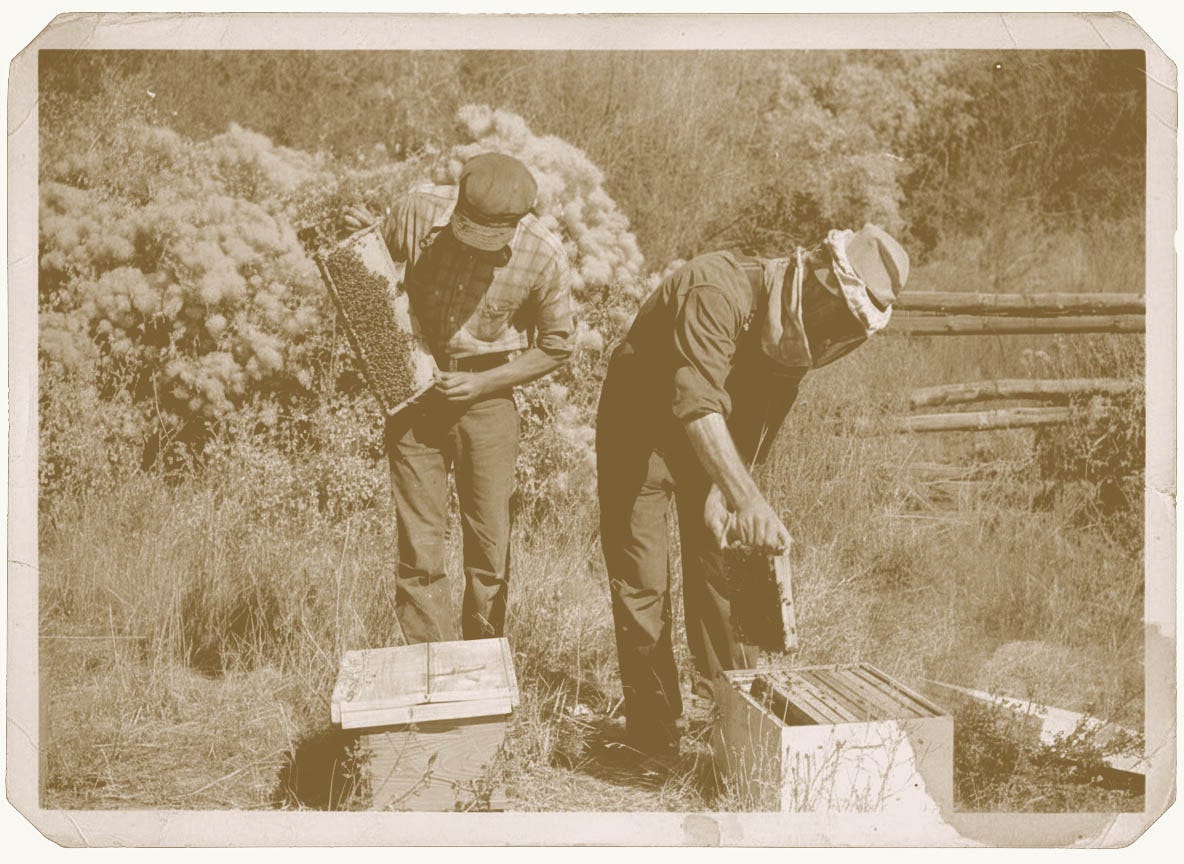
There are two types of work. The first one is in the mind: reading, gaining knowledge, putting it out on a piece of paper. But for me, theories and thoughts alone do not hold up. We need to get out there. Test ideas. Use our hands.
Indeed, in order to have new input, we need to do stuff. Our experiences then are fed back into the loop, helping us improving our thoughts and knowledge. This might be the most basic principle of a system.
But to create truly original thoughts, we have to take it a step further. We have to explore borders and think across domains. This means we have to become generalists. And in this broad scope of interest and insights new connections start to form. That’s the definition of the ecological concept of ‘ecotone‘. And it’s on these boundaries, where it really starts getting interesting.
So sometimes I’ll be the researcher. Other times the writer. Or the filmmaker. The gardener. But today I’m the beekeeper. So, let’s get some work done.
Old Boxes, New Beginnings
Even in late autumn, there are jobs waiting in the apiary. In my workshop, the old hive boxes are stacked against a concrete wall. I need to clean them, get the empty honeycombs out and melt them into blocks of wax.
There I’m standing, looking at that skyline of ancient towers. The faded wood, worn by weather and time. I marvel at its beauty. Each box grows more character with age, the stories of past bees engraved in the grain.
There’s a belief among beekeepers that hives should be painted neatly, factory-style. Indeed, modern apiaries often seem to look like rows of storage units. Well, mine have been outside for years, scattered through my woodland. They’re still up and running.
I do give them a thin coating of linseed oil once in a while. That familiar scent of oil and beeswax still lingers in the workshop.
I use my trusted hive tool to remove the old comb from a hive box. Break it into pieces and drop it into a pot with almost boiling water. As I watch the comb sputtering and melting away, my memory decides to take me back ten years: an image of young poplars and willows among tall grasses.
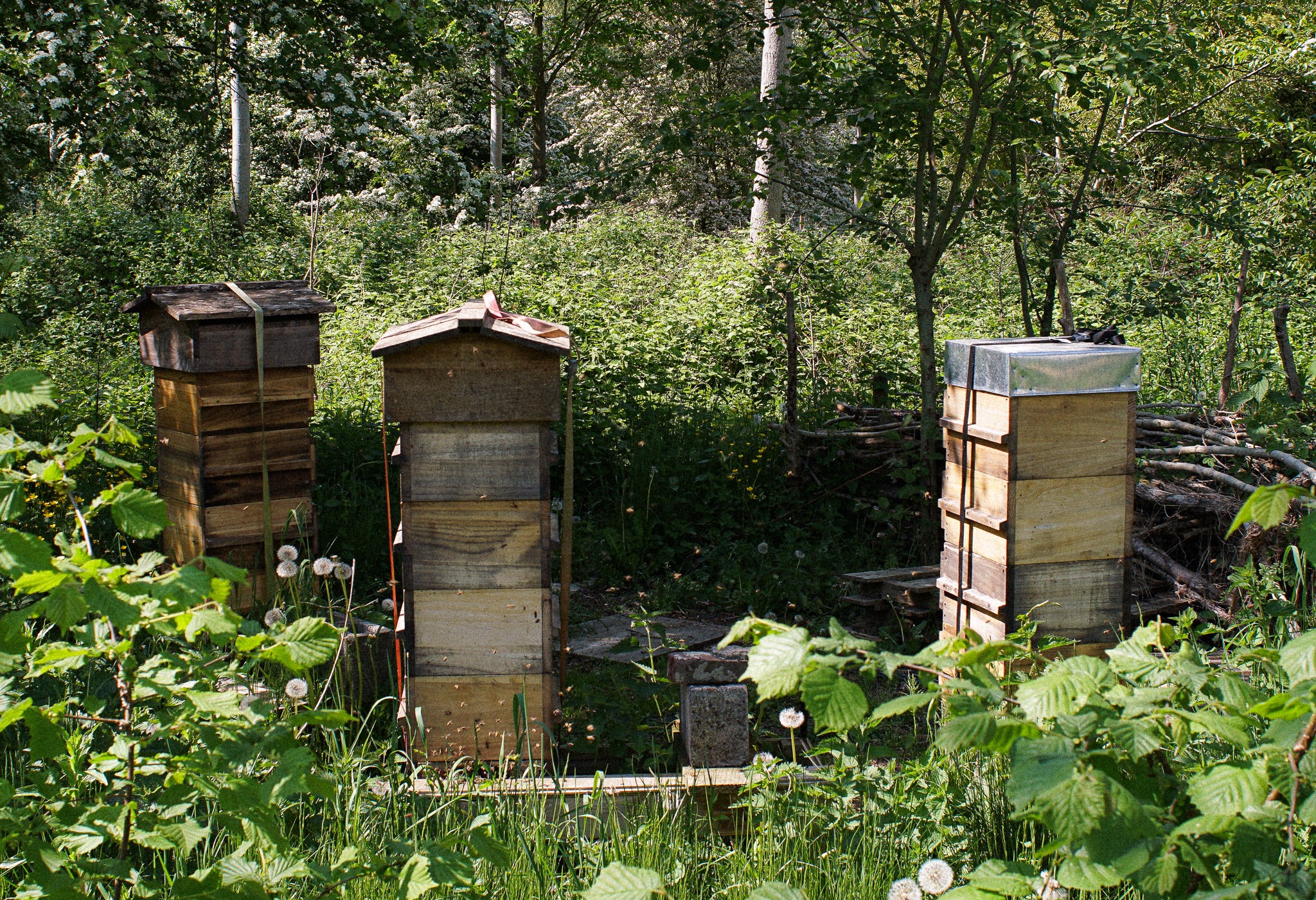
I cleared a circle, mowed it open next to a hawthorn and a young walnut sapling. Two empty hives stood ready, waiting for their colonies. Griet at the wheel, me in the backseat, two buzzing boxes between us. No veil, no smoker, no experience.
That was a nerve-racking drive home: the bumpy beginning of our apiary.
The Advent of Modern Beekeeping: Progress as Control
Of course, like every new beekeeper, I had to decide what hive system to use. I started to read on modern beekeeping, even followed a conventional course. Alas, what I found wasn’t clarity, but confusion. So many systems, so many interventions, so many rules.
Most of these systems had one thing in common. The required lots inspections, lots of equipment, and even more: lots of control.
Beekeeping has always been shaped by inventors and tinkerers: Dadant, Layens, Langstroth, Voirnot, Brother Adam, Badoux, to name a few. All interesting figures, worth further exploration.They brought innovations that deepened our knowledge of bees, but also added complexity.
This was all triggered by the age of the Second Industrial Revolution. Moveable frames, larger comb cell-sizes, bigger and softer bees, “improved” bee-races, factory style management. All those innovations find their origin in the advent of that period. The mantra back then was all about progress and increasing yield.
Take for example J.G. Digges, who, in The Practical Bee Guide: A Manual of Modern Beekeeping (1921), praises Langstroth’s invention of the movable frame as a means to control the bees:
The moveable frame gives free access to all parts of the hive, and admits of the various operations by which control is exercised over the bees, and their labour turned to the best account. [...] bees and combs may be changed from one hive to another as required, queen rearing and artificial swarming may be practiced, natural swarming controlled...
Here’s another one from B.W. Douglass. In his work Every Step in Beekeeping (1921), Douglass succeeds in reducing bees to a factory workforce and transfers the modern credo ‘time is money’ onto the nature of bees.
The ultimate end of beekeeping is the production of honey and if this end is to be gained, the owner of the bees must so manage his insect workers that they are in a position to accomplish the greatest amount of labor in the least time.
Productivity and control became the beekeeper’s creed (and this indeed, still is, the creed of our modern world).
This, by the way, was already envisioned by Rudolph Steiner in that same period. We’re talking about the interbellum period here, the epitome of mass production and consumerism. After WWI the main economic thought was getting things up and running again - improved and better than ever before.
Steiner, who was certainly a Systems Thinker in his own way, studies bees intensively. He went on to interlink their state of being to the larger spectrum of agriculture and society as a whole. He understood the unstoppable forces of progress that the ‘roaring twenties’ brought with it. In a lecture from 1923 he stated:
Today it is impossible to object in any way to the artificial methods applied in beekeeping. This is because we live in social conditions that do not allow anything else to be done. Nevertheless, it is important to gain this insight—that it is one matter if you let nature take its course and only help to steer it in the right direction when necessary, but it is entirely another matter if you apply artificial methods to speed things along.
Or to conclude with the words of beekeeper-researcher Thomas D. Seeley:
When we look back across the 4,500- year history of beekeeping, [...] (we clearly see that) modern beekeeping has given beekeepers better hives. Unfortunately, [...] modern beekeeping has not given the bees better lives.
The People’s Hive: A Different Logic
In the end, I decided for another approach.
A hive named after a French priest, Émile Warré, who lived in the early 20th century. He called it La Ruche Populaire or the People’s Hive. When I mentioned trying the Warré hive to more experienced beekeepers, I was told it wasn’t wise.
Too difficult for a beginner. Too few inspections. Too little control.
But I ignored the advice.
I loved Warré’s premise. It reminded me of a concept called minimum viable intervention in permaculture design. Easy and inexpensive to build, even for the beginner. A design that placed bees, not beekeepers, at the centre. Enough guidance for the colony, never enough to dominate it.
It’s also a perfect example of what William Coperthwaite called Democratic Design. Here is how he phrases it in his work A Handmade Life:
If we sought only simple things - things that cost little, or that could be made or owned by everyone - there would be no need to covet, and things could be raised to their proper level of respect and equality.
This all says a lot about simplicity, possessing skills, and working with the bees (rather than ‘owning’ them). It enables us to work by knowledge and insights instead of blindly following technical manuals and intrusive systems all for the sake of production.
Warré himself described it as a hive that mirrored the natural form of a swarm:
“The form of our hive matches the form and size of a swarm, and it provides the bees more opportunities to stock honey above their winter cluster, which increases their chances for a successful overwintering.”
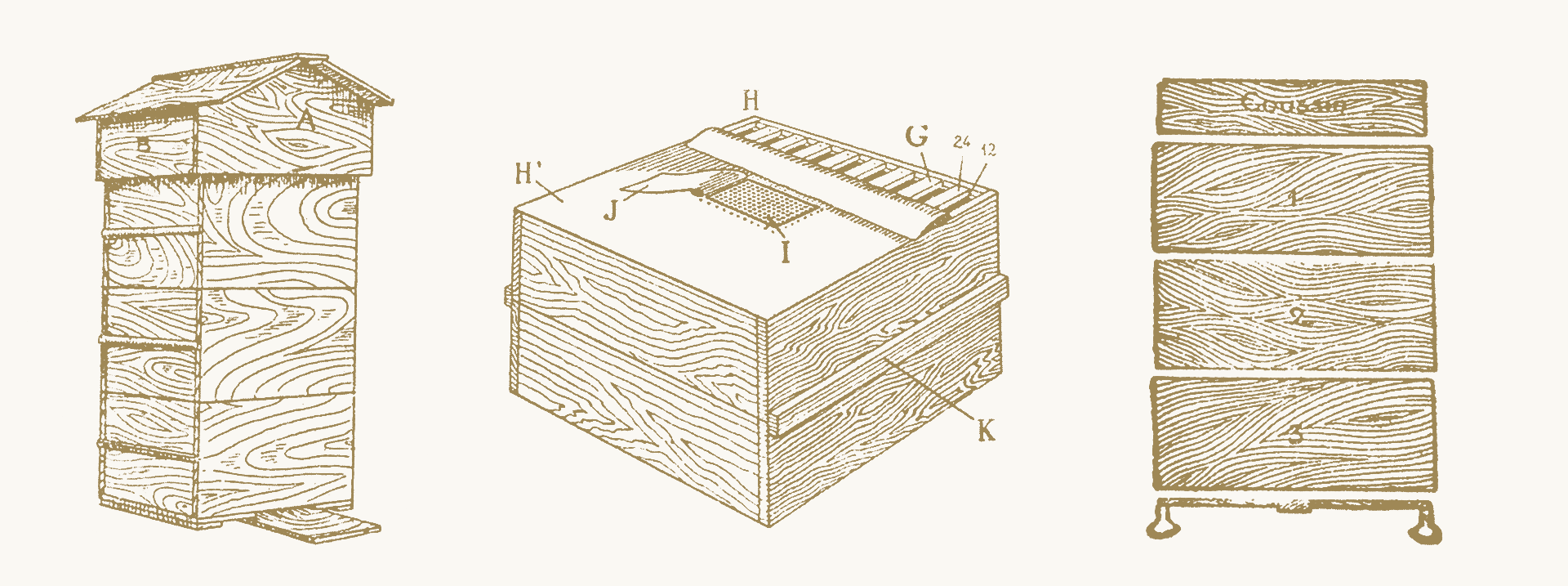
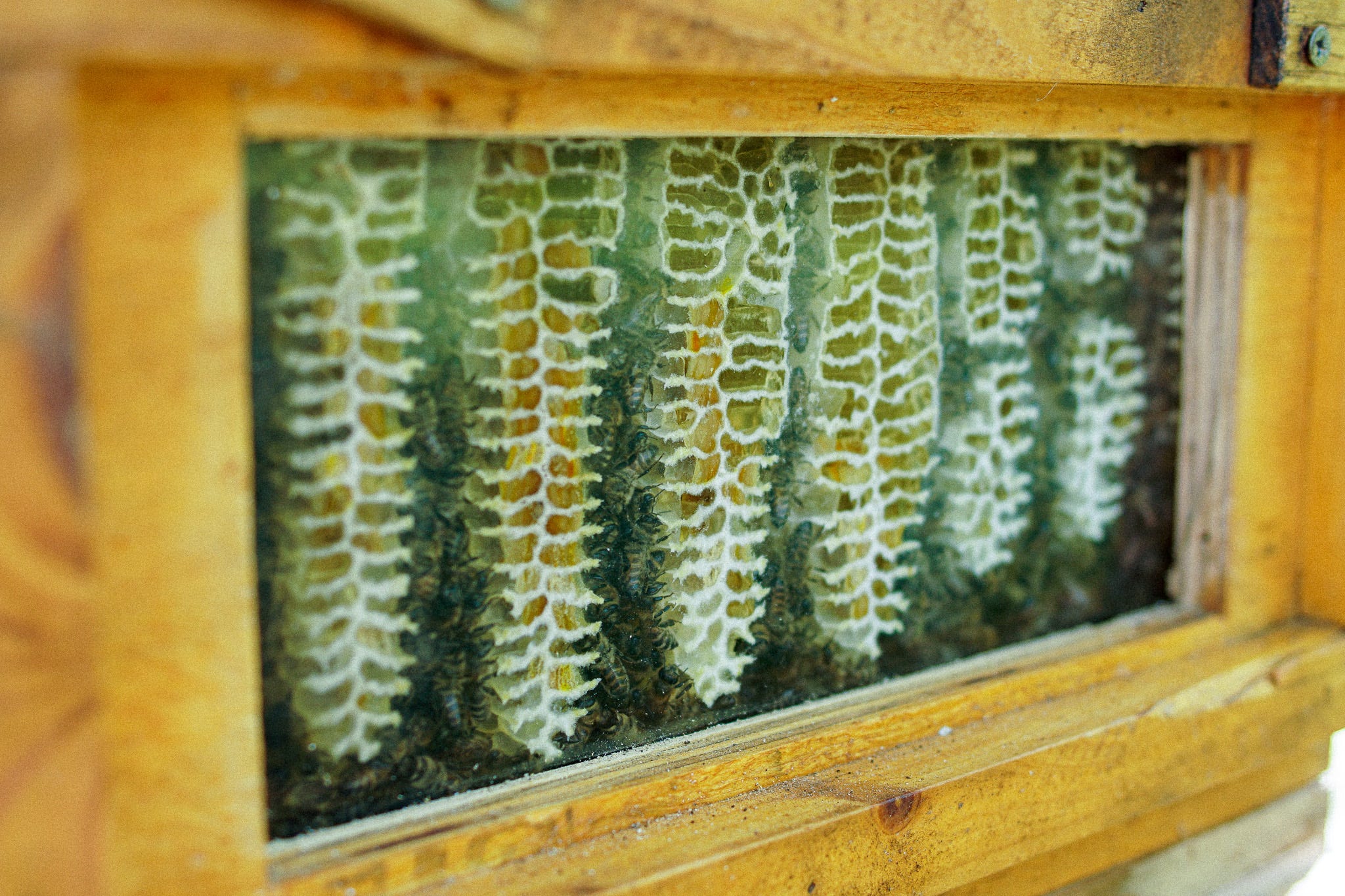
The hive boxes are modest: inside 30 x 30 cm, 21 cm tall, with 8 top bars guiding the comb. No removable frames. The comb attaches to the walls. That single difference set it apart. It brought beekeeping closer to the old days of skeps, where the colony was a whole, not something dismantled for inspection.
Another advantage: the square shape fits the natural cluster of bees in a hollow tree. Heat is retained, energy conserved. As the colony grows, you simply add another box. No brood nest disassembled, no stress from unnecessary handling.
Reading the System: Two Ways of Seeing
If we take a step back, and look at all this from a broader perspective we might envision a hive as a sort of self-correcting system. When the colony grows too large, it swarms. When stores run low, foraging intensifies. When temperatures drop, the cluster tightens.
Or in other words: the bees know exactly what they’re doing. If we fight this natural adaptive behavior we break the internal feedback loop of the hive. And besides: we are, then, not only exhausting the bees but also ourselves.
It would be a better idea to learn to read the bees. Know when to act and when to wait. In a sense, using a system like the one proposed by Warré, forces the beekeeper to do less, and observe more.
One could state, then, that there are fundamentally two different approaches to beekeeping, each creating its own outcomes. The first is a linear system. It uses mostly external inputs and controls the hive though interventions: chemical treatments, sugar feeding, scheduled manipulations etc. The other system is more circular. It focuses on observations first and uses a form of natural selection for establishing healthy, vital populations. It’s more about adaptation and working with the colony’s own patterns and outputs.
Of course, it’s not all that black and white. Most beekeepers implement an approach that’s somewhere in between (they might not even think about it in a systematic way like I do). But still: different structures produce different behaviours. Not because one is “right” and the other “wrong,” but because they follow different logic. Linear thinking asks “what can I add or remove?” Circular thinking asks “what is the system telling me?”
Advantages of Small-scale Beekeeping
Here’s another thought: as small, hobbyist beekeepers, we don’t need to copy the methods and techniques of professionals. We only manage a few hives, not a hundred. That gives us the freedom to choose systems that are more natural, more efficient in their own way, and far less stressful for the bees.
This is the discussion on size and human scale. At two hives, I can quietly sit in front of them and watch entrance activity for hours. At two hundred, that’s impossible. The professional beekeeper must optimize for efficiency across many units. I can optimize for understanding within a few. Different scales demand different strategies - there’s no single ‘best’ method, only methods suited to their context.
We can harvest honey without obsessing over yields. We can work alongside nature instead of against it. We can take our time. And by doing less we often achieve more: healthier, stress-free colonies, better seasonal timings, and results that are both tangible and satisfying.
Swarming: Letting the System Reproduce Itself
For 10 years, I practiced this simple Warré-style method: letting each colony swarm once per year, expanding the apiary naturally.
I live in a rural area, next to a natural reserve called ‘de Getevallei‘ (the valley of the Gete). Letting my bees swarm isn’t that much of an issue. I understand that this might not be the best idea if you are an urban beekeeper surrounded by neighbours and fences.
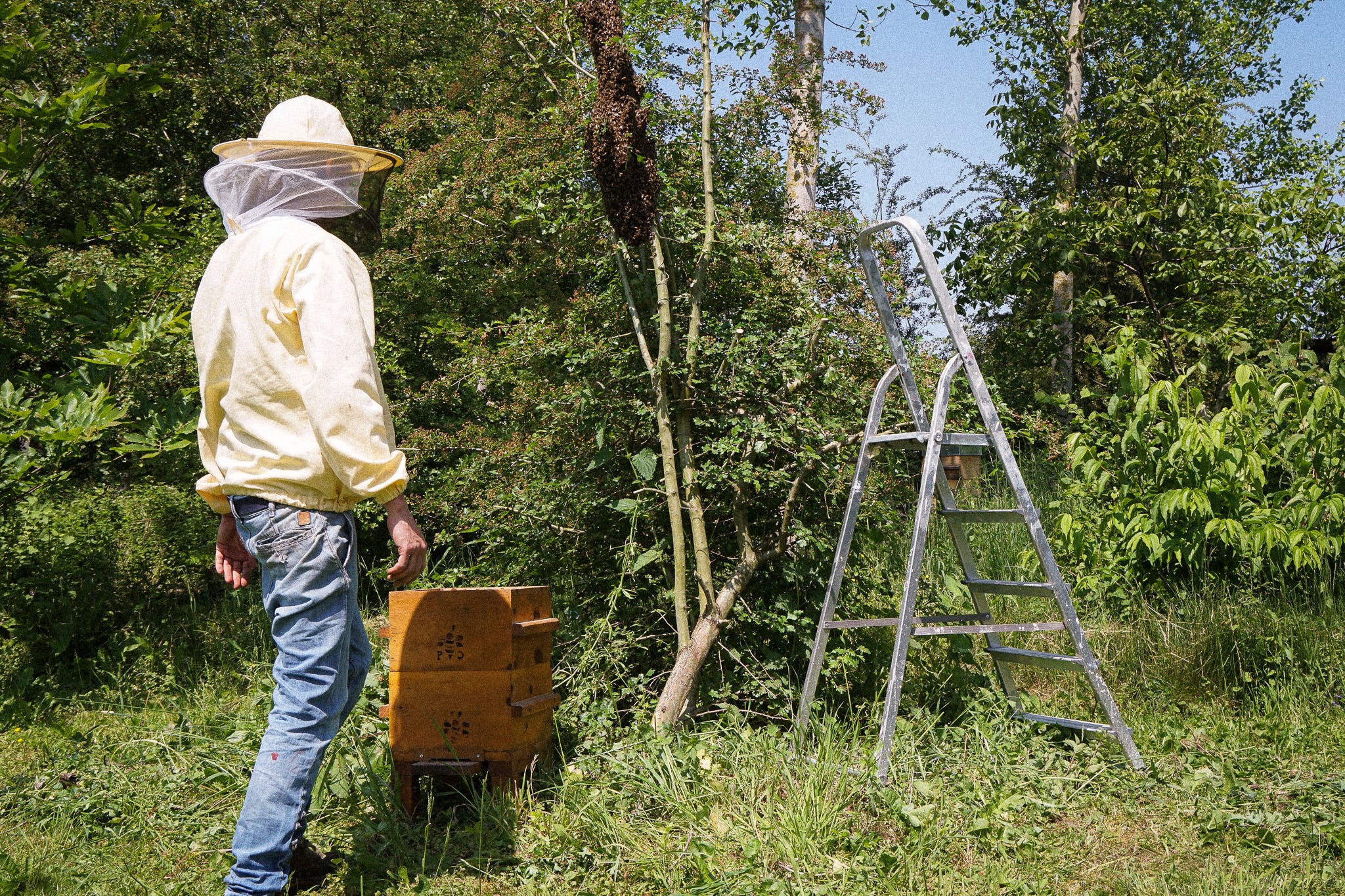
Still, I do believe that letting the bees reproduce in the most natural way, though swarming, is our most viable option for creating a sustainable apiary. It isn’t even that hard.
Wait until the conditions are right and the bees will do the work themselves: the advent of spring flow, masses of pollen and nectar coming in, hives bursting with bees, drones in abundance. The only thing I have to do is prepare some empty hives, maybe set some swarm traps and be mentally ready to climb the occasional tree to scoop out a swarm dangling from a branch.
The apiary, then, emerged from simple rules repeated: allow one swarm per hive, let the new queens naturally mate on site, and yes, from time to time add another lineage of bees, from likeminded beekeepers, to keep the genetics in the apiary diverse.
That’s complexity from simplicity. Abundance from restraint.
It worked. From two small colonies, my apiary grew to 16 hives at almost no cost.
And the bees thrived.
For more than a decade, I avoided the catastrophic winter losses that many conventional beekeepers seem to accept. And each hive, left with its own stores, offered a few kg of honey each season and still left plenty for the bees to overwinter. Not record-breaking yields, but enough for us.
Proof that less can be enough.
What the Bees Taught Me: Learning Restraint
Of course I have to be honest. Not everything is glitter and glamour. Indeed, simplicity can be deceptive. The road towards my current beekeeping system was a steep one. So, when those first two hives in my garden where settled, I had no clue what to do.
In my enthusiasm, I made every beginner’s mistake: opening too often, feeding too much, giving too much space, letting too many swarms go. A handbook teaches the principles, but not the patience. That only comes with experience.
In hindsight I now see that each of these mistakes was a lesson in the art of doing less - the minimum viable intervention I talked about earlier. Every unnecessary inspection stressed the colony. Every premature feeding disrupted their natural rhythm. The bees taught me: intervene with purpose, or don’t intervene at all.
The Warré hive has flaws, like any system. But that’s alright. It’s the same with any creative endeavour. You stack ideas, connect them, let them grow. Sometimes they thrive on their own in the back of your mind. When the time is ripe, you harvest them.
But what we can’t do is force them. Just as we can’t force the bees.
The Shift in Thinking
And here’s the bigger lesson. If I were a novice beekeeper starting from scratch today, this is what I would want to know. What hive model you choose isn’t even that important. What is important is to understand bees as complex and adaptive organisms. To see them as the natural system that they are. And then: to recognise that every action ripples. That timing matters more than technique. That observation teaches more than intervention.
This is the shift from mechanical thinking to ecological thinking. From controlling outputs to nurturing conditions.
This, once more, is true for many layers of our lives. It doesn’t matter which system we use - in beekeeping, in writing, in productivity. What matters is how we use it. Choose one and stay with it long enough to know it inside out. Its flaws, its limits, its rhythm.
Doing less, intervening less, often brings the best results.
Back Outside: Where Theory Meets Practice
Back in my woodland apiary today, the once-mown circle has become a clearing under maturing trees. Six hives of different makings now hum in the shifting light: Warré, but also a hive built after a design by Charles Dadant, and a few mini-pluses.
Old techniques, new insights, all side by side.
I’m back at my workbench. Stacks of old combs patiently waiting for processing, to be used as starter foundations for next years hives. I drain the water-wax mélange through a sieve to separate old cocoons and debris from the wax. Then let it cool down until the pure beeswax forms a solid block, floating atop of the water.
Taking a break, I head over to the apiary. Light flickers across the boxes. The air a mix of fallen leaves and hints of melted wax. Despite the cold, guard bees are pacing the entrances. Here and there a worker bee takes of, looking for a last, late harvest of pollen before freezing temperatures set in.
A small world, ordered and full of motion.
The bees bring calm.
That is what I want my writing to offer as well: a reminder to step outside, to touch soil, to find rhythm again. Not a rejection of modern life, but a balance with it. A minimalist life, shaped by the lessons of bees.
Once more the words of William S. Coperthwaite:
“We need knowledge brought forward from the past, collected, studied, experimented with, and blended together with modern knowledge for the creation of a new culture.”
The old and the new can meet.
Worn boxes and new hives.
Past mistakes and fresh insights.
Old crafts and new technologies.
That circle of learning, like the circle of bees, keeps turning.
Doing less, whether with bees or words, often gives us more than we expect.
Most of us work with screens and ideas instead of soil and seeds. But the principle is the same: care for a small plot, whether it’s a garden, a story, or a hive, and it will reward you.
Not everything depends on adding more. Sometimes the best action is restraint.
In the Archive
Ideas and concepts drawn from and inspired by:
Émile Warré’s Beekeeping for All (1948) · Rudolf Steiner’s Bees (1923) · J.G. Digges’ The Practical Bee Guide (1921) · B.W. Douglass’ Every Step in Beekeeping (1921) · William S. Coperthwaite’s A Handmade Life (2003) · and Thomas D. Seeley’s The Wisdom of the Hive (1995).
Each wrestled with the same tension: progress or patience, control or care.
Each, in their own way, traced the shift from mechanical mastery toward ecological trust.
To work well with living systems is to know when to guide — and when to stand aside.
If this piece gave you something to think about, I’d be grateful if you passed it on to another keeper or reader who might benefit.
Join the Cycle
If this reflection resonated, consider subscribing to The Perennial Workshop.
Each season we explore how small systems — from hives to creative practices — sustain themselves through attention, rhythm, and restraint.
→ Subscribe to follow the cycle.
This is the first of your essays that I read. Reading through it, I felt I was learning more about bees, along with tte more philosophical ideas. The way you connected the parts from practical experience and intellectual reflection seemed woven together in a natural way.
One of the lines that really struck me was 'Proof that less can be enough.'
It reminds me of an idea I had read from Naval Ravikant about how when we feel we have enough we feel satisfied and by extension, we stop buying or consuming. Therefore, with products and services, it's best for marketing to convince us that we lack something, that we 'do not have it all.'
Loved this, wish you were my neighbour when I attempted beekeeping at the beginning of our farming journey! So hard to find like minded people here, the idea of doing something non-convential, forget about getting any sort of support!