
Soil as Archive
From industrial fertilizer to circular gardens: notes on decay, return, and building systems that last

This essay moves through:
A first garden and the mistakes that come with beginning
Historical ideas that shaped modern agriculture
Small-scale market gardens that worked with decay, not against it
What soil can teach us about building durable lives and work
In my previous writing called ‘Towards Winter Rest’, I reflected on the importance of timing and season, and how these ideas relate to a practical, resilient life. Somewhere near the end, I added a Maeterlinck quote, where he paints an image of the bees who ’like ourselves, obey the wheel that incessantly turns on itself’.
I find this concept of a cyclical nature, and the recurring processes that determine life and destiny, fascinating. In my own small library of references I’ve noted a set of formulations of this idea as expressed by various authors.
Back when I was a student, I somewhere found a concise edition of Robert Burton’s The Anatomy of Melancholy (1621). I used to carry it in my pocket, skimming its tiny pages for insights. It’s an otherworldly exploration into the human mind and condition: part scientific, part philosophical.
According to Burton, the natural hierarchy of nature is an infernal one:
”Minerals are food for plants, plants for animals, animals for men, men will also be food for other creatures, but not for gods, for their nature is far removed from ours; it must therefore be for devils…”
— Robert Burton, The Anatomy of Melancholy (quoting Cardan’s Hyperchen)
The Stoics, of course, also contemplated this loop called life. Marcus Aurelius, in his Meditations (book IX, 28), finds that we all ‘...shall quickly be underground; and ere long the earth itself must be changed into something else, and that something into another form, and so on to infinity.’
Wendell Berry, in his essay Quantity versus Form, mentions the ‘Wheel of Life’—a concept first coined by Sir Albert Howard in his important work on soil. Albert himself borrows the term from ‘an eastern religion’. The Wheel of Life is constituted of the successive and repeated processes of birth, growth, maturity, death, and decay.
Death supersedes life and life rises again from what is dead and decayed. — Sir Albert Howard, The Soil and Health
Frank Fraser Darling, in one of his lectures on ecology, talks about ‘Energy flow and recycling (as) the essence of organic existence’. He observes a common flaw in our perception of nature: man, in the image of God, on top of a hierarchical food pyramid. The inheritance of a Judeo-Christian worldview. His conclusion: there is no such thing as a one-directional, top-down flow. Life is far more complex than that. It’s cyclical.
We all, then, will decay, like good compost does, and become food for the earth: the minerals that feed the plants. We’re all part of this eternal cycle. That’s the core of Perennialism.
Ashes to ashes. Dust to dust.
For now, let’s step down from the heavens (or hells) into the concrete particles of the sticky soil beneath our feet. Let’s follow the practical example of Helen and Scott Nearing: divide the rhythm of our days between study and practical labour.
From City to Soil
In my student years, when I still lived in the big city - Brussels - I had no clue about gardening and nature.
I studied film and rarely ventured outside except for a night out or a trip to the supermarket. However, the city had its own kind of nature. Asphalt-bound dandelions, roots wedged beneath paving stones. Vacant lots thick with nettles, thistles, and stray mustard plants, between discarded mattresses. Ring-necked parakeets occupied the parks: loud and brazen.
Nature will always find a way. Even between concrete and steel.
In the evenings, we watched murmurations of starlings from our balcony. They seemed to understand the city better than we did. They swirled through the air, turning and folding, until they settled on the cold, steel arms of a construction crane.
Perhaps they wondered what we were doing there.
But in the end, the city was not really meant for us. Too many people, not enough air to breathe. We didn’t know exactly what we were looking for. Only that we had to get away from the hurry.
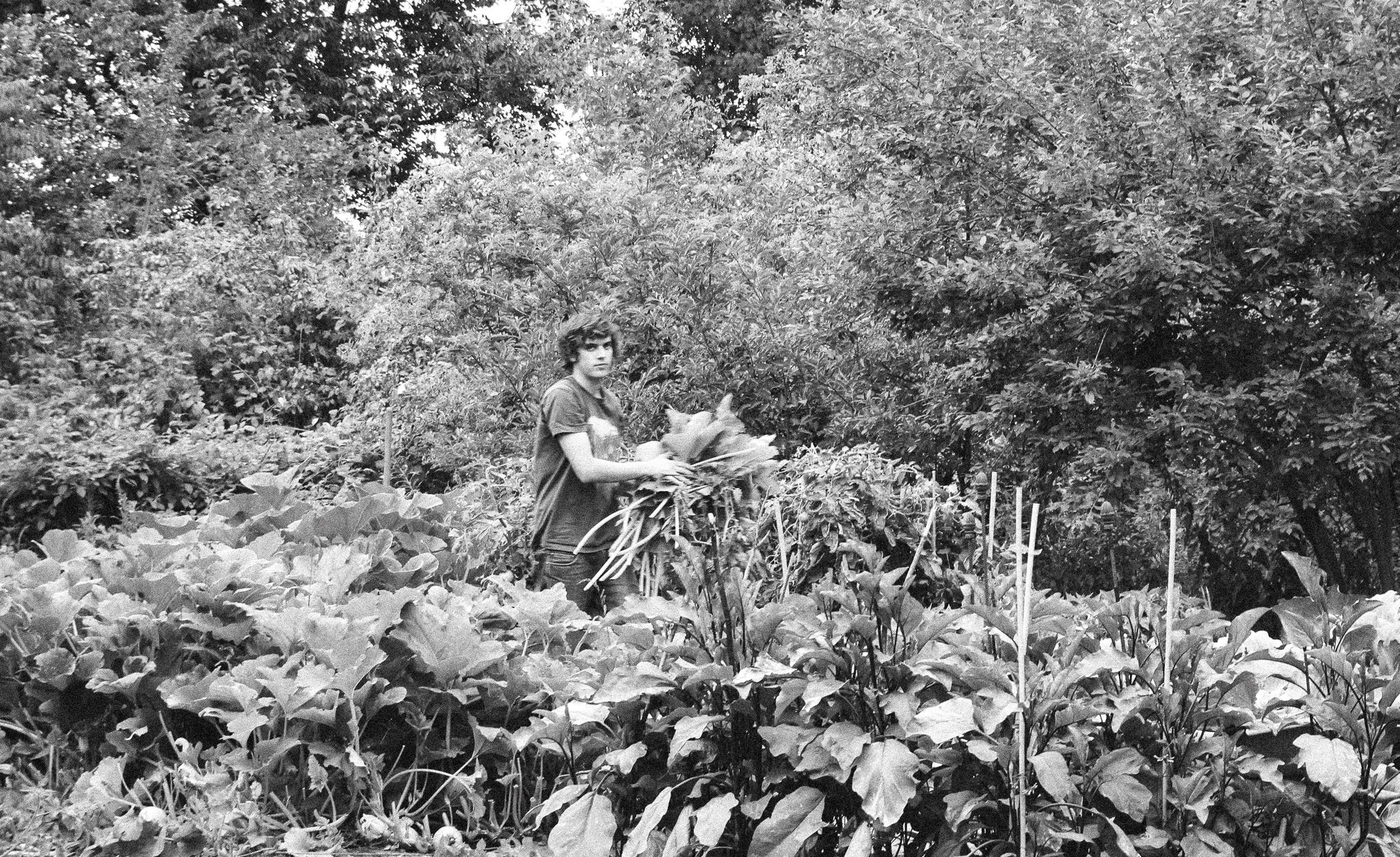
Then came the chance to live in the empty farmhouse of Griet’s grandparents. A small homestead with a huge barn, a wild fruit and vegetable garden wedged between strips of suburban housing.
We knew nothing about gardening or self-sufficiency. Still, we began. The smell of wet grass in the morning. The song of an early blackbird on the roof ridge. Grass gave way to vegetable beds, the orchard was gently restored.
Step by step, the outside world opened up.
The madness and arbitrariness of big city life started to fade. Instead, the possibility of a modest form of independence and agency began to nest in my head. Being outside, simply doing some honest labour, and the feeling of belonging and stewarding a place - it felt innovative and refreshing.
The Promise of Order
When I first started gardening, I did what most beginners do: I used fertilizer. A relative donated a package of organic N-P-K. The promise of abundant yield compressed into little light-blue pellets of manmade ingenuity. And it worked; I grew the biggest cabbages of my life.
This promise had a history. In 1840, Justus von Liebig published Organic Chemistry in Its Applications to Agriculture and Physiology. He reduced soil fertility to measurable variables: nitrogen, phosphorus, potassium. The complex web of life became a formula:
The food of plants consists of inorganic substances: carbonic acid, water, ammonia or nitric acid on the one hand, and potash, lime, magnesia, iron, phosphoric acid, sulfuric acid, and silicic acid on the other.
Von Liebig’s work was brilliant and important. But in the typical mood of the post-Industrial Revolution ‘Zeitgeist’, he broke down the complex foundations of soil-building into the smallest possible fragments. What he presented was a promise of order. The unraveling of soils and fertility into strictly measurable variables. Each element a cipher in a universal formula.
No more guessing. No more waiting. Just repetition: buy fertility, apply fertility, repeat. In this prophecy, the farmer was a manager of one-directional flows. The field a straight line: input, growth, output.
Efficiency as gospel.
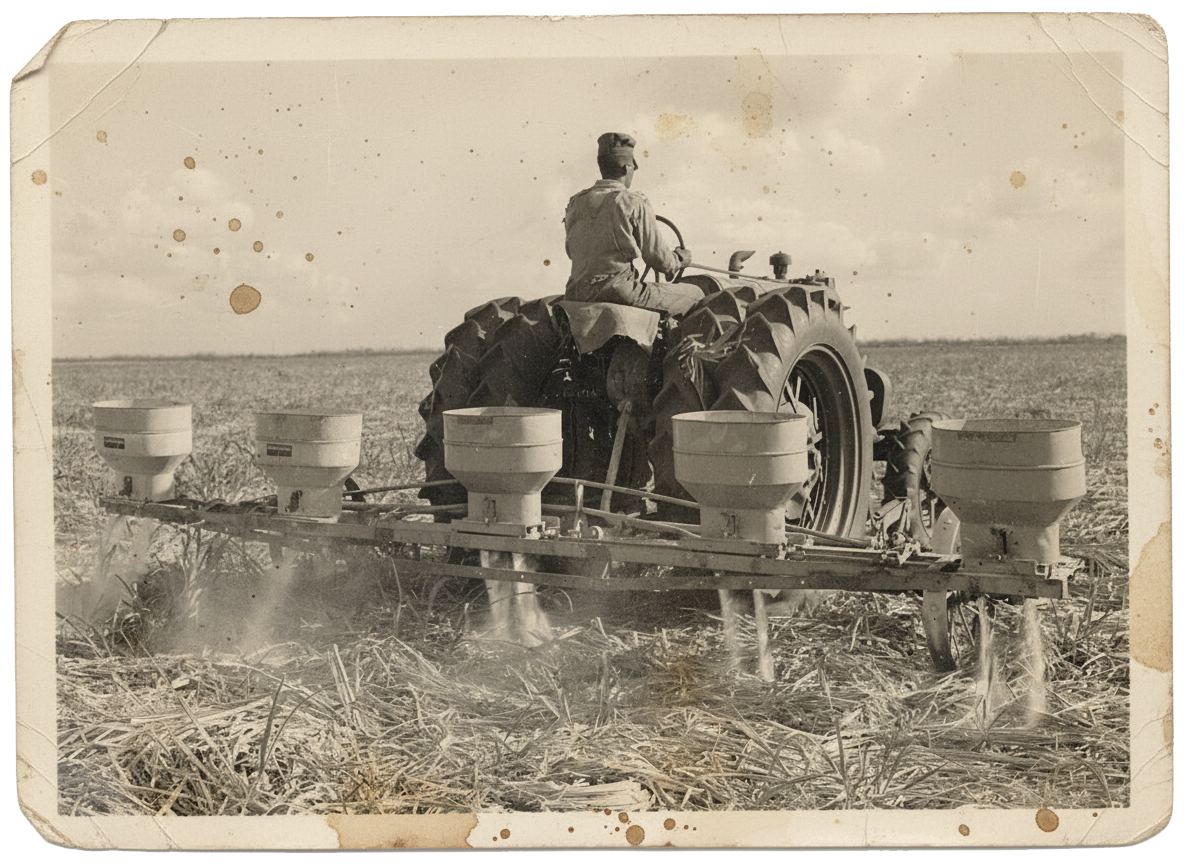
But let me tell you: that system is a hungry one. It cries to be fed all the time. So, the next year one drives back to the garden shop and buys yet another dose of these factory-made promises. The little patch of soil one tends becomes addicted to external resources.
The incarnation of a linear system.
The same thing applies to the vast majority of agricultural land that surrounds us. Every hectare a mirror of another. Efficiency in the form of endless repetition. Cultivated nature becoming a synonym for clinically sterile production lines.
What fertilizer gives, it also withdraws. The invisible web of life underneath our feet slowly vanishes. Yet the inorganic never disappears. Phosphates accumulate in rivers, dead zones blossoming offshore.
This all felt not right. So, I decided to go cold turkey. No more external inputs. No more quick fixes.
The Alternative Archive
There had to be another way. I needed a system, but not the reductionist one I’d been sold. So I started digging that infinite library called the Internet Archive, looking for historical texts on farming.
That’s where I stumbled upon alternative visions: Peter Kropotkin’s Fields, Factories and Workshops (1898) and Benjamin Rowntree’s Land & Labour (1911). Reading these accounts, I began to realize my small efforts were part of a much older story.
Both works include studies of the market gardens of France and the smallholder farms of Flanders. Kropotkin defines them as models of high productivity through closed-loop, intensive cultivation. Rowntree noticed that on those farms nothing was wasted: manure was preserved, fields manured two or three times a year, and much of the work was done with a spade. Small plots, carefully tended, rivaled the productivity of the largest farms.
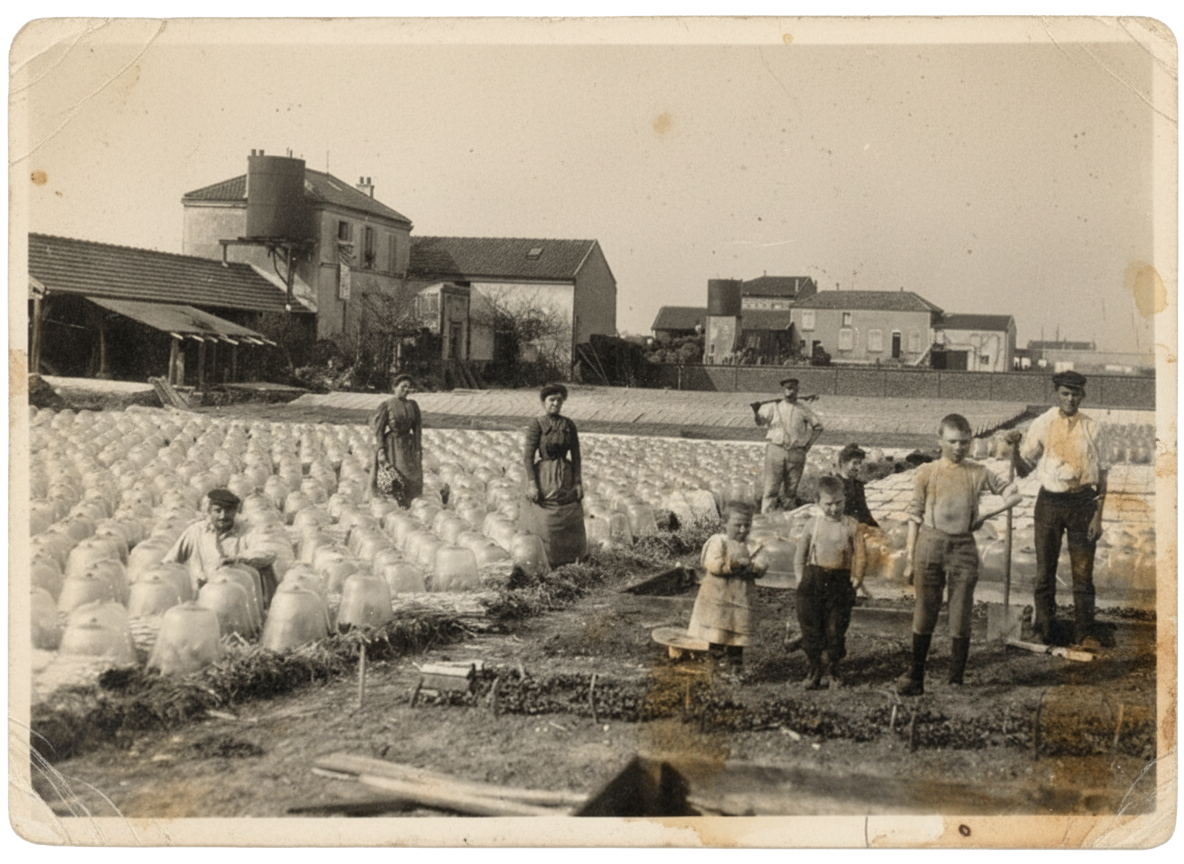
One might regard these communities as the last bastions of Gallic resistance in times of perpetual modernization and reductionist thinking. Of course, these gardeners were exponents of an older system.
Their formula was not N-P-K but C–O–H–M: compost, oxygen, heat, manure. The manure of the horse that carried the vegetables became the heat that germinated its seed. Nothing was wasted, because nothing could be spared.
These kinds of gardens spark my imagination. I picture a whirling patchwork of diversity. A hustle and bustle of farmers distributing manure, ventilating hothouses, placing glass cloches over juvenile salads, harvesting cucumbers and directly reseeding carrots. A communal system that lives. Each garden a feedback loop of matter and time.
Kropotkin visited those gardens and wrote, astonished, that “we no longer know what is the minimum area a family needs.” Rowntree, counting bushels in Flanders, found yields that defied both common sense and imperial arithmetic. Their testimonies were not romantic but empirical: they saw in these humble systems the complexity that industrial order had suppressed.
What distinguished these maraîchers from the modern agronomist was not technology but tempo. One worked with the cycle of decay, the other against it. One cultivated diversity; the other uniformity. One trusted feedback; the other trusted formula. And yet, in both, there was the same desire: to feed life through design.
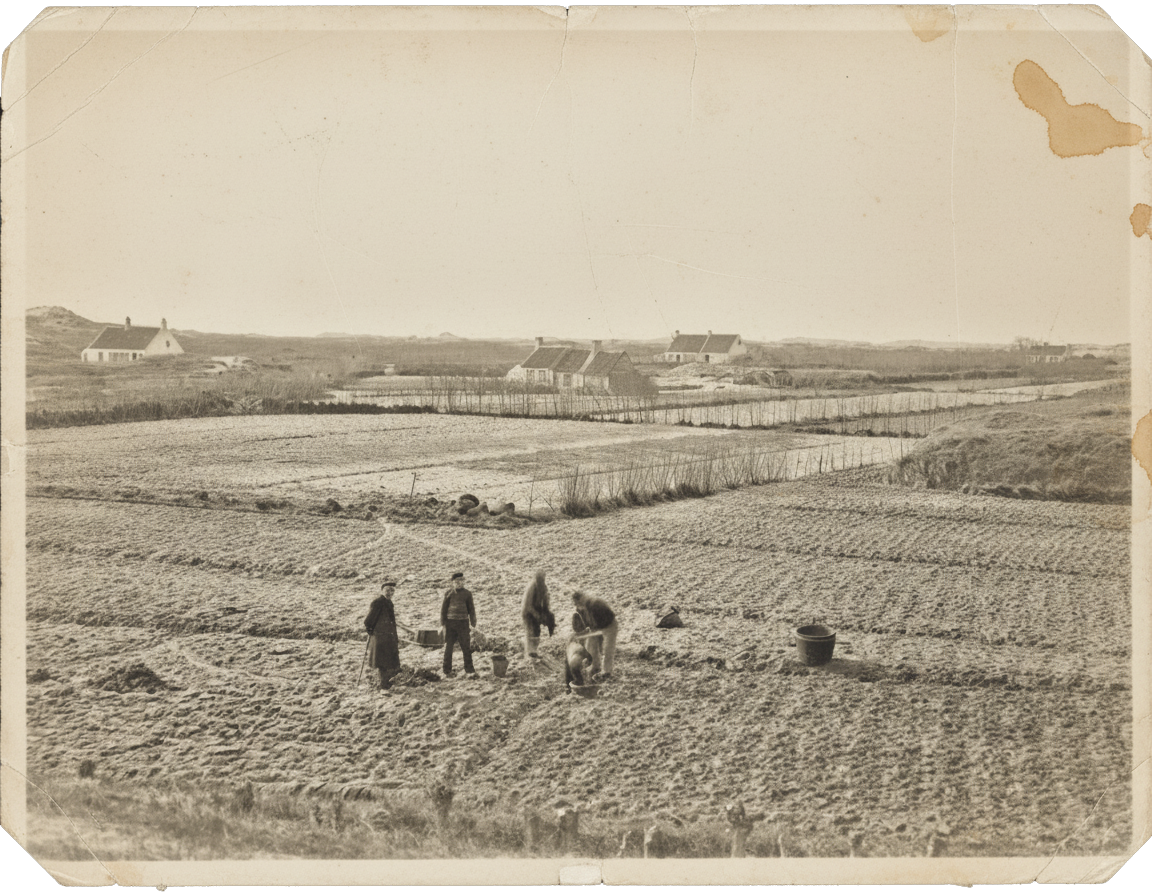
Reading these historical accounts on circular farming in France and Belgium somehow felt like reading something else. It felt like reading a manual on complexity, feedback loops, and diversity at the edges. Indeed, we tend to think of “systems thinking” as a modern discipline, but this history shows us that people have long designed adaptive, resilient systems without ever naming them as such.
Abundance didn’t come from scale but from cycles of attention, renewal, and adaptation. Their plots weren’t just productive; they were regenerative.
Inheritance and Practice
Looking back at my own story, all of this does make sense. My grandparents tended their vegetable plots. Griet’s grandparents were farmers. Permanence doesn’t necessarily have to be about ‘place’ only. It can also be about the inheritance of practice, tradition and knowledge. That as well, is an incarnation of perennialism.
So we continued our gardening endeavors. Now with a clear system in mind: small-scale, intensive, circular.
And I don’t think I’m the only one who longs for a link with the land. Somewhere, in most of us, there is an image - perhaps from childhood - of being outside. A park we knew, the smell of sun on grass, or a hazy photograph of a garden long gone.
You don’t need a farm for that. You don’t even need a large garden.
A patch of soil will do: a backyard bed or a few pots on a balcony. And maybe a vision of beauty and sustainability.
The question isn’t whether you have the space, it’s whether you’ll use it or not.
It’s about that small measure of resilience, a sliver of self-sufficiency, doing for ourselves the things we’ve outsourced for too long. It’s about reconnecting with locality and place, and knowing where you belong.
Wendell Berry, returning to the countryside after city life, wrote in his 1968 essay A Native Hill:
“One has made a relationship with the landscape, and the form and the symbol and the enactment of the relationship is the path…”
Berry saw topsoil itself as exemplary:
“It is enriched by all things that die and enter into it… It keeps the past not as history or memory, but as richness, new possibility. Its fertility is always building up out of death into promise.”
And so we’re back at the beginning and the true nature of life: everything feeds back into the system. Every decay is food for a fresh start.
The Logic of Return
Sometimes, after work, I head over to the compost heap and just start adding bits and bites: some leaf litter, weed cuttings, branches from pruning, a bit of chicken manure. The air starts filling with the scent of fresh earth as the sun sets behind me. And after half an hour of piling, a neat heap of future fertility starts to grow.
For me, there is no more satisfaction than these little moments, working the garden: clearing a pathway, a bit of weeding in the border or maybe, if I’m too tired, just strolling around, dreaming of future improvements to the system.
In front of my kitchen window, I watch as clouds of steam dissolve from the mulched garden beds into the chilling air. A living demonstration of organic decomposition. The vegetable plot, the orchard, the little pond with the two ducks, and the wild borders. And in the background, silhouettes of beehives, and the forest edge still covered with remnants of shattered leaves. I watch the chickens, eagerly scratching and turning heaps of garden waste.
In our time, most of us work with screens and ideas instead of soil and seeds. But the principle is the same: care for a small plot, whether it’s a garden, a story, a film project, and make it durable. Give it the right care and make it part of your own system. It will reward you. Not because it’s big, but because you gave it attention.
Compost, then, is the raw material of ideas: mental notes, scraps, and half-formed thoughts. They feed the mental garden where projects take root. What grows there is shared. What’s left returns, breaking down into something new. Even the waste becomes fuel for the next season. This, then, is the true apparition of the wheel Maeterlinck saw turning - neither moral nor mechanical, but continuously emerging from its own natural intelligence.
And sure enough, new ideas start to hum in the air. Like bees moving over a field of white clover, carrying the work further than we ever could alone.
In the Archive
Other nodes on Perennialism:
On Resilience and the Art of Balance - Building a system to anticipate change
Trusting the Process - Doing less to achieve more
Drawn from the compost of older minds:
Maeterlinck’s Life of the Bee (1901) · Burton’s Anatomy of Melancholy (1621) · Marcus Aurelius’ Meditations (c. 170-180 CE)· Sir Albert Howard’s The Soil and Health (1940) · Frank Fraser Darling’s ecological lectures (1940s) · Kropotkin’s Fields, Factories and Workshops (1898) · Rowntree’s Land and Labour (1911) · Berry’s A Native Hill (1968) and Quantity versus Form (1970).
Each turned the same soil, each found life rising again from what decayed before. Each investigated the concept of perennialism through renewal.
To build something lasting, we must build it so it can return.
Join the Cycle
If this piece resonated with you, consider subscribing to The Perennial Workshop.
Each season we explore how systems — ecological, creative, and personal — sustain themselves through attention, rhythm, and return.
→ Subscribe to follow the cycle.