

This writing is part of my reflections on Thinking in Systems, called The Pattern Catalogue. Each Entry can be read as a stand-alone, but benefits from the previous ones. Today’s Node follows the steps of Entry 004, as I explore the emergence of decisions without a central leader.
There is a distinct advantage to rising before the sun: witnessing the profound beauty of daybreak. You watch the light change from obscure, blackish-blue hues to the piercing of an orange-faded sun through the skyline.
From my kitchen window, looking out over the pond, the vegetable garden, and the maturing forest, the same scene renders itself into a different painting every fifteen minutes. It is a morning observatory. The entire landscape coming to life. The shadows shift from absent to faint, then to harsh contrast as the sun goes up. A little scene to catch each morning before I start my routine of writing.
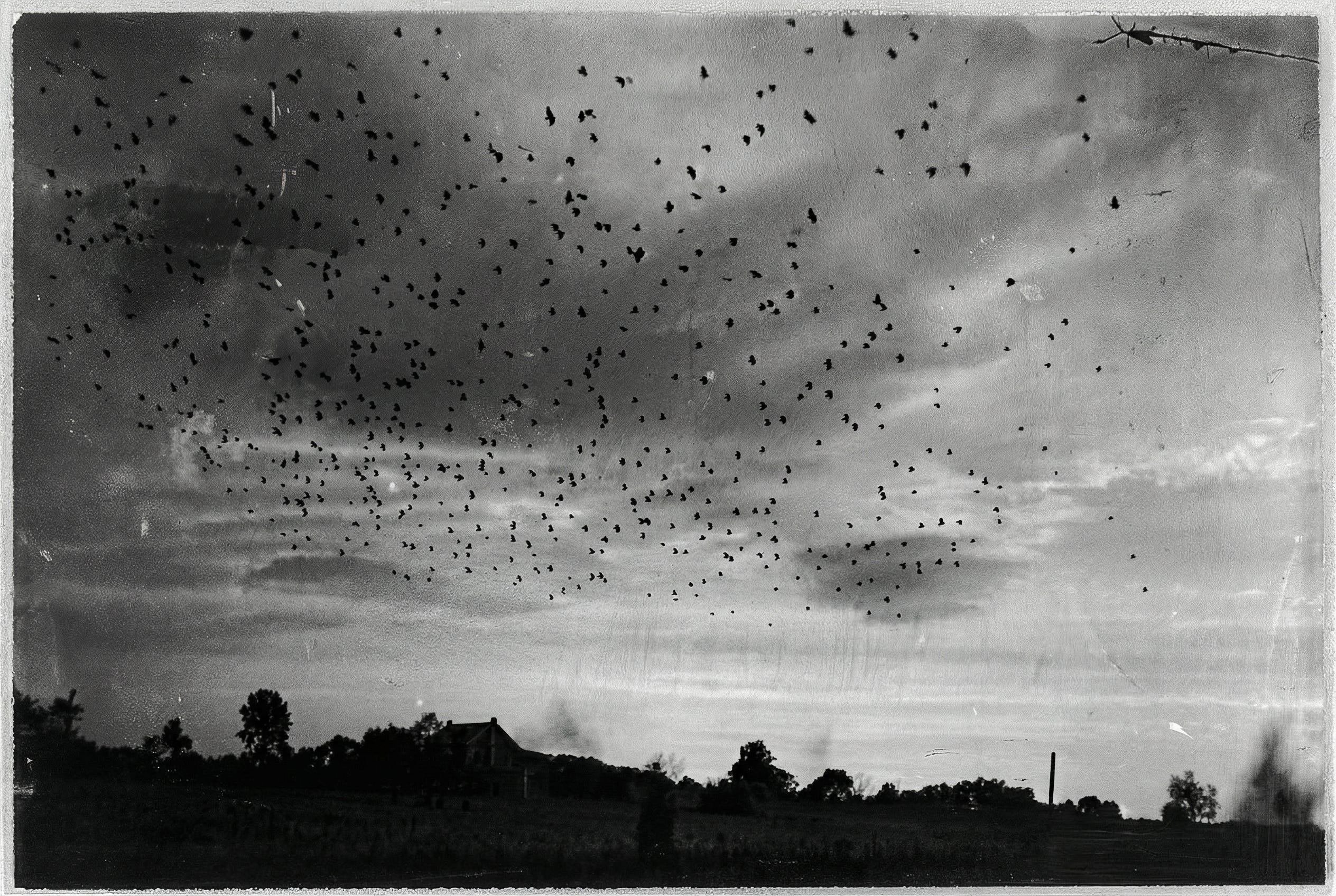
Then, suddenly, the starlings shoot out from the bamboo border where they’ve spent the night. They emerge in dancing murmurations, turning into waving clouds that shift against the sky.
And then I wonder: how does that process actually work? Who has the lead? Who decides which direction to take?
So I thought, why not make a small detour and look at how decision-making shifts from the individual towards the group. And what that tells us about a very old and very important idea: how the many can be wiser than the one. To do so, I want to introduce three concepts that are part of the same flow:
Complex Adaptive Systems → Swarm Intelligence → Stigmergy
Stratosphere Level: Complex Adaptive Systems
Witnessing the clouds of starlings in the garden, I thought of the bees. In Entry 004, I touched upon the topic of distributed intelligence: how there is no single bee in command. Not even the queen.
It reinforced my belief in the importance of decentralization. Complex and important decisions can be made by a group, by relying on simple, local rules. No leader needed.
But it’s more than a personal stance or observation. It’s part of modern systems theory. It even has a name: Complex Adaptive Systems, or CAS. However, we shouldn’t let the terminology intimidate us. Let’s switch on Pattern Mode, and explore the different components.
It’s Complex because the elements inside the system are nonlinear and diverse, and each one acts on the limited, local information it has available.
It’s Adaptive because those elements interact, and to survive, they continuously adjust their behavior based on new experiences and changing conditions.
And it’s a System because it is a collection of elements that together form a networked whole.
Examples of Complex Adaptive Systems are to be found everywhere, from a colony of bees to the neurons in our brains, from the biosphere to the stock market, from political systems to Artificial Intelligence.
For now, here is the crucial takeaway: In a well-functioning CAS, no one is shouting orders from the top down. Organization and behavior emerge from spontaneous, bottom-up processes that cannot be predicted by looking at individual parts.
To come back to my own terminology: the language of the Mechanic is grounded in a singular worldview. It’s all about taking things apart and trying to fix them by looking at symptoms and the individual components. It’s the language of blueprints and static machines. Let’s contrast this with the organic language of the Gardener, who embodies the CAS through ecology, evolution, mutual aid, and exploring the bigger picture.
Cloud Level: Swarm Intelligence
Adaptive Action
Now let’s move down one level.
Traditionally, the perception of classic environments — from institutions and workplaces to households and gardens — is rather mechanical and linear. Management relies on the idea of a fixed order, a blueprint and a foreman.
The logic is top-down: Command → Action.
However, if we start looking at these same environments through the lens of a CAS, the whole thing changes. Coordination becomes emergent: a result of the whole being greater than the sum of its parts.
The logic is cyclical and bottom-up, an Adaptive Action: Action → Mark → Action.
Here is how it works.
Individual agents within the system take action. That action causes a change in the environment (a feedback loop!). The agents, then, sense the new state of the system, the “mark,” and modify their next action accordingly.
This is Swarm Intelligence: the ability of a collective to produce intelligent, coordinated behavior from the bottom up, without any central authority directing the process.
I find this very intriguing. What we observe here is a simple yet overarching concept that describes the true state of nature. And it provides us with the tools to rethink our thinking: from the monarchy of the individual to the democracy of the collective.
This “ghost in the hive”, then, is not some mystical emanation; it is a solid biological observation.
The Swarming Process
One of the fantastic “extras” of beekeeping is the privilege of witnessing this collective intelligence every time a hive decides to swarm.
When a new queen is about to be born, the old queen leaves the hive, joined by thousands of worker bees. They cluster somewhere on a nearby branch. That’s when an important decision-making process starts: deciding upon a new home.
Here is how it works.
Hundreds of scout bees fan out across the surrounding landscape, searching for potential nest cavities. When a scout discovers and inspects a possible new dwelling she runs a checklist to see if the cavity complies with certain objective criteria: volume, entrance size, height above ground, etc. She then returns to the cluster to advertise the site using a waggle dance.
But of course our scout is not alone. Others have found some good locations as well. And so, a waggle dance competition unfolds. The scouts promote their findings.
But here is the distinction: the better a proposed site matches the quality criteria on the checklist, the more persuasive the scout will dance. And the more persuasive a scout dances, the more followers she attracts.
Those followers, in turn, go to inspect the site themselves, and, if satisfied, join the original scout in her dance.
In the end, the superior site accumulates a rapidly growing number of independent endorsers through positive feedback loops. Finally, the scouts perform frenetic buzz-runs through the swarm, triggering the entire colony to launch into the air and follow their guides to the new home.
This entire process is Swarm Intelligence in action. It emerges from thousands of individual bees making simple decisions based on local information. It results in what researchers like Thomas D. Seeley in his Honeybee Democracy (2010), describe as a statistically optimal collective decision.
But Swarm Intelligence, like the waggle dance, relies on direct, peer-to-peer contact.
Which raises a new question: Can decisions also be made without these direct interactions?
What happens when the agents aren’t standing right next to each other? What happens when they can’t feel the waggle dance?
Ground Level: Stigmergy & The Desire Path
The Shared Memory of the Collective
We’ve covered quite a bit of dense ground. What we’re actually doing is clearing a path, step by step, through a thicket of ideas; machete in hand, slashing away the overgrowth that blocks the view, until suddenly the horizon reveals itself.
To use the language of Vertical Literacy: we’ve traveled from the Stratosphere (Complex Adaptive Systems) down through the Clouds (Swarm Intelligence). Now let’s zoom in further, to Ground Level, and look at a specific pattern in the human landscape to answer that exact question.
CAS → Swarm Intelligence → Stigmergy → The Desire Path
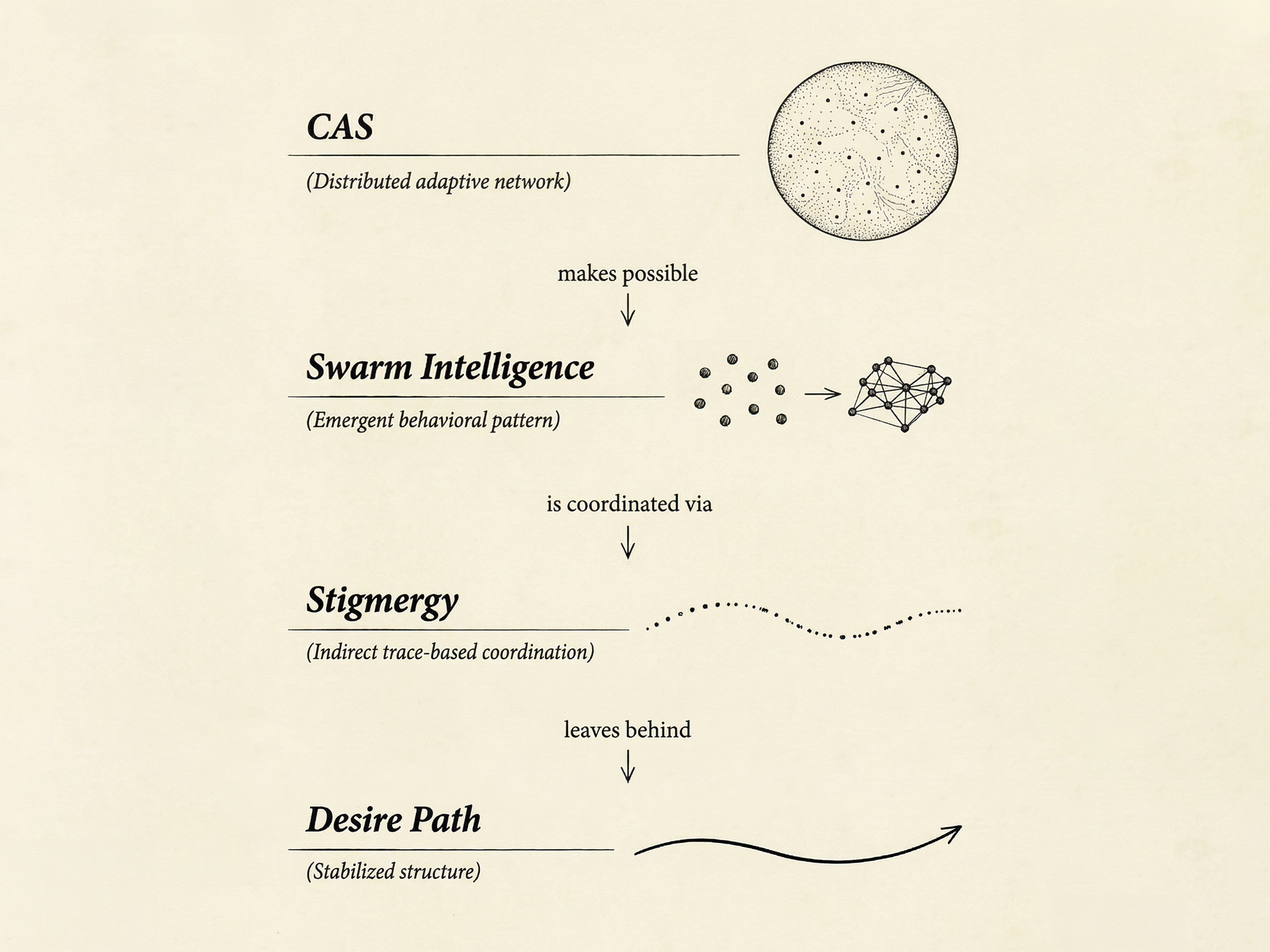
Here, I want to introduce a concept coined in 1959 by French biologist Pierre-Paul Grassé: Stigmergy.
Stigmergy describes a mechanism of indirect coordination. Instead of communicating directly, agents leave traces (marks) in the environment for the next agent to respond to.
The environment itself becomes a kind of shared memory of the collective: the language of the Commons, allowing thousands of individuals to build complex structures without a single architect.
A perfect example of this is a so-called desire path. A desire path is an unplanned, functional trail formed by the repeated foot traffic across a manicured lawn, often bypassing any existing paved sidewalks. Why? Because it’s simply the most efficient route from one point to another. And that’s the route people tend to take.
The first person walks across the grass, leaving a trace. The next person sees the slightly flattened grass and follows it, flattening it further. The feedback loop strengthens until an unofficial, perfectly optimized path emerges, completely bypassing the paved corners designed by the architects and mechanics.
It perfectly captures the friction between the engineered world (the paved sidewalk) and the natural, emergent world: the desire path. It shows that humans, despite our Cartesian illusions of control, still operate like a hive when left to our own devices.
A Reinforcing Feedback Loop
The desire path is a physical reinforcing feedback loop. The more it is walked, the clearer it becomes; the clearer it becomes, the more it is walked. As Donella Meadows reminds us, structure determines behavior. The desire path is behavior becoming structure.
Action A (leaving a trace) increases the likelihood of Action B (following the trace), which reinforces Action A (making the trace stronger). This creates what theorists call path dependence: historical choices (or in this case, footsteps) establish a dominant design.
And so we return to the idea of Adaptive Action: Action → Mark → Action. Or more simply: more footsteps → clearer path → more walkers.
We do not learn alone. Coherence is a shared product. The path learns the walker by taking shape, and the walker learns the path by adjusting their gait.
And so, stigmergy becomes the language of the Commons.
We can witness it on open source platforms like Wikipedia, too. A user leaves a seed of an idea (a draft article or a piece of code). Other users refine, edit, or build upon it. And without central design, complex, curated projects start to emerge.
Back to the Murmurations
Back at the kitchen window, the murmuration of starlings slowly dances out of sight. I now understand that these complex shape-shifting patterns are an emergent property.
The flock forms from the bottom up. There is no central control. Each bird follows simple, local rules, like the distance it keeps from its immediate neighbors. The result is one of the most breathtaking patterns in nature. And not one bird planned it.
Here are some final thoughts.
The desire path is very intriguing. It’s an idea that speaks to the imagination.
However, for the most efficient path to emerge, we need both diversity and independence. This means we can make decisions based on our own knowledge and not based on the actions of others. When each agent can make decisions based on their own genuine assessment rather than following others, the collective result is naturally more intelligent. This, then, is the opposite of herd thinking.
To state it differently: when independence is lost, the system breaks down.
And lastly, we should remind ourselves that the most efficient path isn’t necessarily always the best one.
Sometimes we need to meander, too.
Next Wednesday: Entry 006 — On Literacy & Language
We have seen how complex systems build paths through interaction. But what if we can't see those paths because we lack the words to describe them? Next week, we tackle the syntax of Systems Thinking, exploring how upgrading our language is the first, essential step to start reading the patterns.
A Note on the Commons
I am keeping The Pattern Catalogue open to everyone because I believe we all need these tools to rethink our thinking. If these writings offer you insight and value, consider becoming a paid subscriber to support the workshop.
A fascinating read as always :-) I love how you use the starlings to illustrate the concept. As you probably know, my starling murmuration capture note went viral here on Substack. It's great to see it explained so eloquently.