

This entry marks the end of the first season of The Pattern Catalogue. I am calling this first collection of ideas The Optic, as every entry has been about learning to see systems.
In the previous Entry 006 | Distinction, we already foreshadowed the idea of boundaries through language and naming.
But naming is only part of the game. Every time we name, distinguish, and observe, we are building something larger: mental models.
Season 2 will build on that capacity. We will move from learning to see systems to examining the invisible forces that shape their behaviour.
And models, it turns out, are everything.
Opening the Hive
Spring is approaching, and with it the start of a new beekeeping season. Last week we did a quick first inspection of the hives. After all these years, I still find that exciting: how are the colonies doing?
It is a routine check, and once we open the hive we immediately see what is happening.
Because of the warm winter, there is already a lot of brood. We observe a nice brood pattern and brood in all stages (what beekeepers call BRIAS). Nurse bees are concentrated on feeding the brood and keeping it warm. There is still plenty of honey in the stores. Foragers are already flying in with yellow clumps of pollen. There: the queen, on the corner of a frame, surrounded by attendant bees. On the bottom of the frames, others have already chained together to start building new comb.
The hive is healthy. It is time to add another box.
And every first inspection takes me back to my starting days as a beekeeper. I remember bringing my first two colonies home and opening them for the first time. Yes, I had some theoretical knowledge. But no practice whatsoever.
So what happened when I opened that first hive?
In one word: chaos.
Ten thousand bees. A mass of movement and noise without order. No logic. Just an overwhelming density of living things doing incomprehensible things.
Same hive. Same ten thousand bees. Entirely different reality.
Absolutely nothing changed in the hive. What changed was the mental model available to me.
The Map and the Territory
In the hive I know what the different parts mean: brood, propolis, comb, drones, queen.
So when I open the hive, I know what to expect.
But that expectation is not reality. It is a working simplification of it: a model.
We can imagine that model as a small-scale map: a set of reference points and relationships that allows us to navigate without being overwhelmed.
But the bees are not a map. They are a living organism.
Every hive is different. Some colonies grow fast, others slow. Some are calmer, others more defensive. Some swarm often, others hardly at all.
All of these are emergent properties of the hive. They are not on the map itself; but without the map, we wouldn’t even know to look for them.
This is how any map works. You walk a landscape and mark what is stable enough to orient yourself by. A bridge over a river can go on the map. It has location, form, distance.
The clouds do not go on the map. Neither does the smell of the meadow after rain, or the way the path floods every February. These are real. They are part of the territory. But they cannot be fixed onto a static representation.
Every model includes and excludes. That is not a flaw. It is what makes it useful. A map that contained everything would be as useless as no map at all.
The map is not the territory.
In systems thinking it reads like a mantra. And yet it gets forgotten all the time.
Our perception of the world depends on the models available to us. But the usefulness of those models depends on how well they correspond to the real world. That, then, is a classic case of circularity.
The Boundary Is Not a Wall
Every model draws a boundary. By choosing what becomes part of the map, we also choose what is left out.
Donella Meadows points out that systems rarely have real boundaries. What we experience as a boundary is often a mental construct: an artifact of the model, not a feature of reality.
Gerald Weinberg offers a useful reframe. A boundary, in systems terms, is not a wall. It is an interface: a point of interaction between two systems. Or, as I would call it, an ecotone.
“Interface” is a more useful word than “boundary,” for it reminds us to pay attention to the connection, and not just the separation, between system and environment.
He adds an interesting analogy using the Roman two-faced god Janus. Each system looks in two directions simultaneously: inward toward itself, and outward toward the environment.
Let us return to the bees for a tangible example.
To industrial society, bees have become a commodity. Little honey factories. If the demand for honey rises, modern economics either asks beekeepers to produce more or relies on imports. In that model, the problem appears solved.
But that model excludes other factors. More bees in local apiaries can mean more pressure on local ecosystems. The landscape may not provide enough carrying capacity. It means more pressure on beekeepers. Imported honey introduces questions of purity, transport costs, climate impact, and ethics.
The solution was designed inside the model. The consequences appeared outside it.
This is what Meadows calls the trap of the narrow boundary. It is one of the most common failures in thinking and decision-making.
Inherited Maps
Everything we see and think is framed through the mental models available to us.
But here is the thing:
We did not choose most of them.
Most of the models we use are inherited. They are passed on through parents and education, through culture and language, through religion, ideology, or the political system we were born into.
Patrick Hoverstadt calls this the “conceptual baggage that we carry around,” much of it “the ideas of long dead people”:
Shakespeare has pertinent models for a lot of things, but not for micro-plastic pollution, for example.
By the time we are old enough to examine our models, we have already been living inside them for years. Most people never examine them at all. They never realise that their thinking is preconfigured by inherited maps.
Meadows puts it directly: our mental models are deeply ingrained assumptions, generalizations, and pictures that shape how we understand the world and take action. They act as filters. We tend to see what our models equip us to talk about.
And yet we do need them. They are what shape chaos into order when opening the hive.
Drawing Your Own Map
We can learn to design mental models for ourselves. Whether this concerns our perception of nature, a boundary in the garden, the way we understand a team, or the way we imagine the process of writing this newsletter.
To consciously draw a map of a system is an incredibly useful skill. It increases our ability to make deliberate choices. It is an act of agency.
Most people never make that crossing. They spend their lives navigating by a map they were handed at birth, assuming it is the only real one because it is the only map they have ever held.
But this first season of The Pattern Catalogue has been about developing the tools to draw a personal map. Pattern Mode over Topic Mode. Holism over fragmentation. Vertical travel. Emergence. Distinction. Each entry has sharpened our ability to see the systems we are part of. And seeing them is the prerequisite for redesigning them.
So let us raise our modelling game: moving from the tacit to the explicit. From the map we inherited to the map we draw ourselves.
You cannot draw a new map without first stepping outside the old one.
Finding Your Position
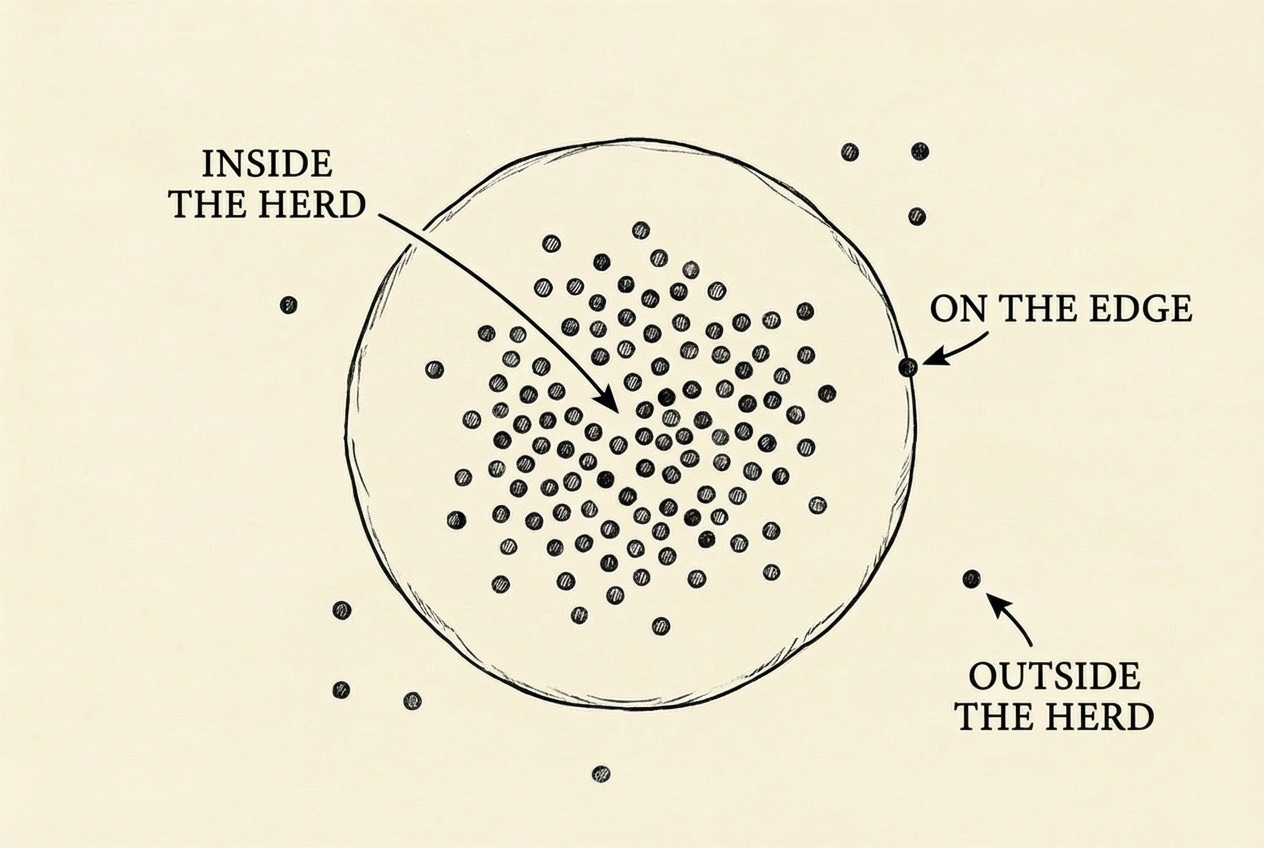
Here I want to build on an image borrowed from Patrick Hoverstadt.
Picture a herd of animals moving across open land. Now place yourself somewhere relative to that herd.
Position One: Inside the herd.
You are surrounded by others moving in the same direction. The direction of the herd is the direction. It barely occurs to you to question it, because you cannot see anything else. This is what it looks like to be fully inside a system without knowing it: inside an ideology, a profession, a culture, a family pattern.
Position Two: On the edge of the herd.
From here, you can see the open land. Other herds in the distance. Other possibilities. You are still part of your herd, but you can now see that it has edges. You begin to understand that its direction is a choice, not a natural law.
Position Three: Outside the herd.
From outside, you see the whole. Your former herd as one pattern among many. How groups overlap, where they conflict, how they relate. The boundary reveals itself for what it is: a line on a map.
Not a wall. An interface.
Crossing the Borders
When we cross a boundary, we are not merely changing our viewpoint. Crossing borders means change. And change means emotion.
That is why boundary crossing is uncomfortable.
Inside a social system, belonging to one group often means not belonging to another. It feeds the common idea of we versus them.
One of the clearest signs that a boundary exists is exactly that emotional resistance: the moment a conversation shifts from the plural “us” to the singular “you.”
But there is a way to work with that resistance rather than be stopped by it.
Hoverstadt calls this boundary hopping: the ability to step outside a system to see it clearly, then step back inside to act within it.
The degree to which you can see a system depends on being outside it. The degree to which you can influence it depends on being inside it.
The skill lies in moving between the two without losing both perspectives.
This is vertical travel, applied laterally. Entry 003 taught us to move up and down through levels: from detail to whole. Boundary hopping is about moving sideways: between systems, between herds, between inherited maps. Together they form the same underlying skill: holding a position lightly enough to leave it when needed.
The practice is simple to describe and difficult to do. It means loosening the grip of inherited models and becoming open to drawing new ones.
A small practice, then:
Pick one boundary you are currently reluctant to cross. A conversation you are avoiding. A perspective you dismiss before fully hearing it. A system you defend without examining it.
Notice the emotional charge. Name it.
Then cross.
Concept Card
Mental Models
An internal map of reality used to navigate complex systems.
Mechanism
By drawing boundaries, a model selects what to include and what to leave out, reducing chaos into navigable order.
Result
We stop blindly following inherited maps and gain the agency to design our own.
Next Up: Entry #008
Season 2 begins. We have learned to see systems and to move between them. Now we look inside: at the invisible forces that shape a system’s behavior from within. First up: Feedback Loops.
Navigating The Pattern Catalogue, Season 1: The Optic
Pattern Mode → Holism → Vertical Literacy → Emergence → Swarm Intelligence → Distinction → Mental Models
Coda
Although I thoroughly enjoy researching and writing this grammar of systems, it does take a great deal of effort. From now on I will publish these entries bi-weekly rather than weekly, to keep the rhythm sustainable.
A Note on the Commons
I am keeping The Pattern Catalogue open to everyone because I believe we all need these tools to rethink our thinking. If these writings offer you insight and value, consider becoming a paid subscriber to support the workshop.
one can go up or down vertically; move across borders; define boundaries and interfaces; percolate and look into mirrors.............yung