
The Patchwork Issue 2: Orchard
On pruning rituals, the universe called apple, and the invention of gravity.

Like every year, I’m late in the season to prune the apple trees. Then I suddenly realize that spring is rapidly approaching, and I need to spring into action.
I guess I could just leave them as they are, adopt the philosophy of Masanobu Fukuoka in true One Straw Revolution style. Fukuoka left his fruit trees unpruned and observed how wild fruit trees create different, smaller fruits with unique tastes. His “one-straw” or “do-nothing” method— the idea that nature is perfect as it is — is fascinating.
But the canopies start to get crowded, lots of water shoots. And that young, vertical growth tends to drain energy from the trees. So a bit of thinning and shaping will do the trees rather good.
Patch 1 | Entering The Orchard
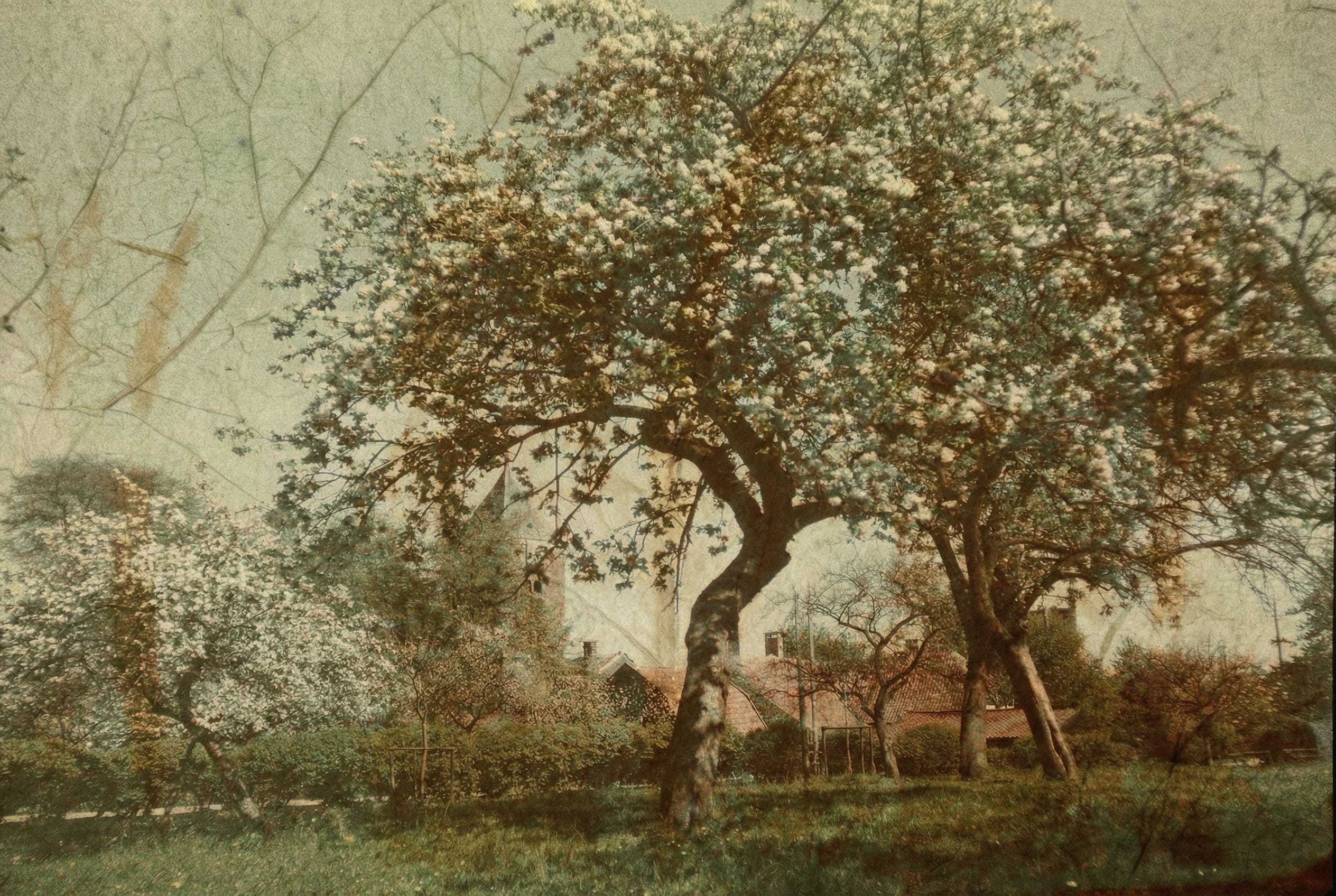
I was once told by an old pruner that we must prune trees to be exceptionally airy: so open that you can throw your hat through the branches without it getting stuck. This is especially true for the old, high-stalk trees (what we call hoogstam in Dutch).
Also, I actually like the once-a-year seasonal work of pruning the trees. It has become a sort of ritual, marking the transition between winter and spring. And just like coppicing, it actually stimulates the trees to invest in new growth, which helps the setting of future fruits.
The branches and cuttings have their use, too. I’ll tie them together and use them as kindling for the stove.
The apple reflects the cyclical idea very well: prune in winter, enjoy the blossoms in spring, harvest late summer, make cider in autumn. And so on.
Meanwhile, I have the privilege of watching the entire thing prosper and grow. The canopy broadens, the trunks thicken, and the microclimate beneath the tree shifts: adding shade and structure.
The apple tree and the orchard, to me at least, is a perfect reminder of the local, the idea of permanence and place.
So, there I’m standing, outside, on a chilly morning, pruning scissors at the ready, envisioning the job to be done. Before me, the empty orchard, a bunch of scattered trees and the barren branches. A few stubborn apples still clinging to the twigs as if their lives depend on it. The refusal to surrender to the pull of gravity.
And, like always, my mind starts to drift. How fascinating can one single object be? Isn’t that apple an entire universe of ideas in itself?
As I kept pruning tree after tree, that universal idea of the apple kept occupying my thoughts.
Patch 2 | The Universe Called Apple
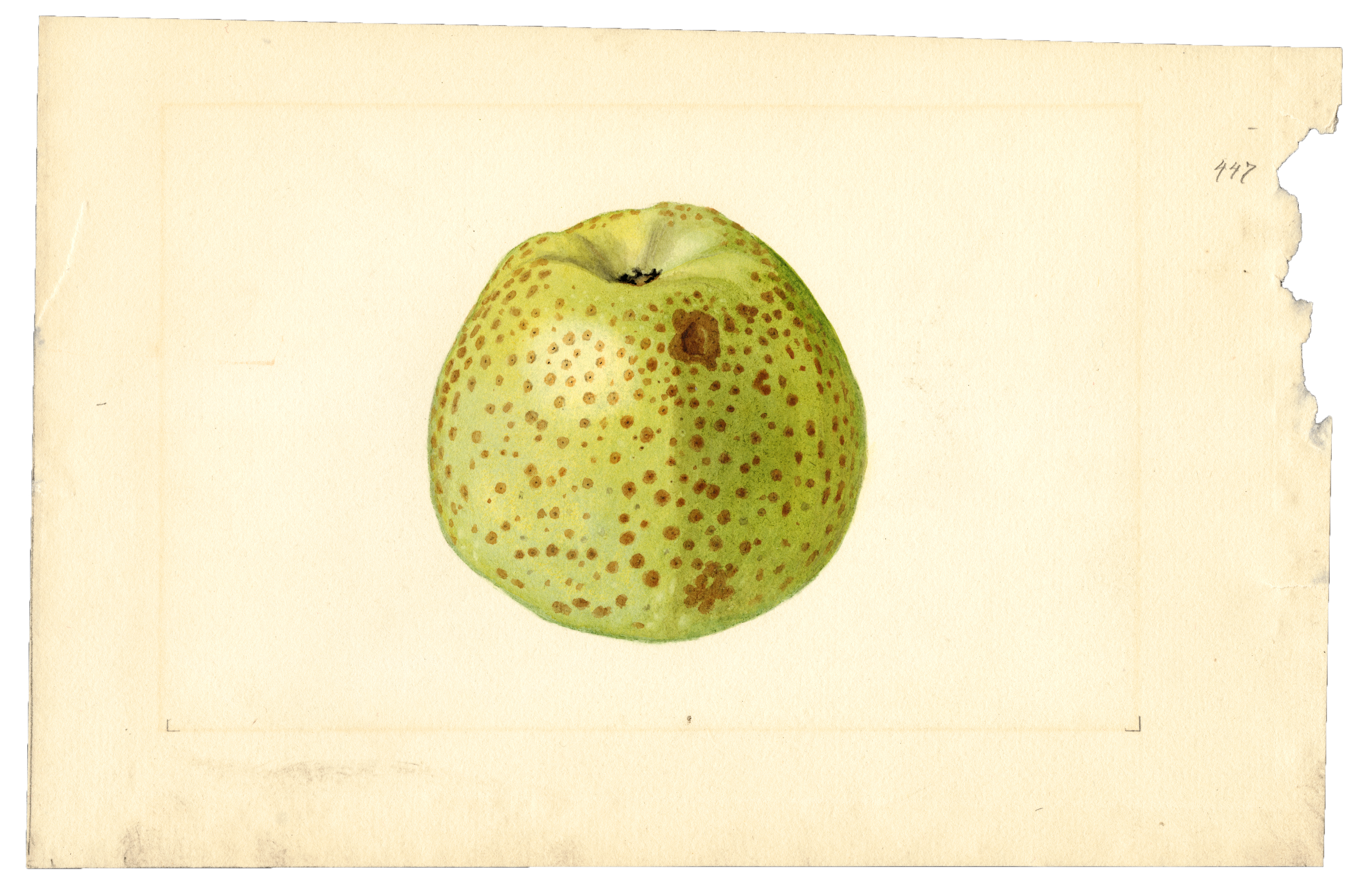
Later that day, back inside the house, I try to unravel a bit of the apple’s mystery. It’s Gaston Bachelard who confirms the idea of an apple as a universe on its own.
In The Poetics of Space, a work from 1958, Bachelard explores how the domestic environments we inhabit shape our internal lives and creative imaginations.
Somewhere, discussing the idea of miniature worlds, he cites Cyrano de Bergerac, who states that: “This apple is a little universe in itself, the seed of which, being hotter than the other parts, gives out the conserving heat of its globe; and this germ... is the little sun of this little world”.
The apple...what a marvelous universe. In our region, the apple has a long history. It’s embedded into the landscape, there are still many remnants of old orchards.
Sadly, most of them have been replaced by modern monocultures of low-stem varieties.
But when we trade the old apple for the new one, we trade a diverse living organism for a standardized, sterile variant.
The apple falls from the tree. Gravity pulls it to the ground. Suddenly it enters a decentralized, self-organizing network called earth. Wasps, worms, yeast, soil microbes, and finally the seedlings all interact with it. The apple becomes truly part of another universe that feeds an entire network before it becomes part of the soil.
Patch 3 | The Modern Apple
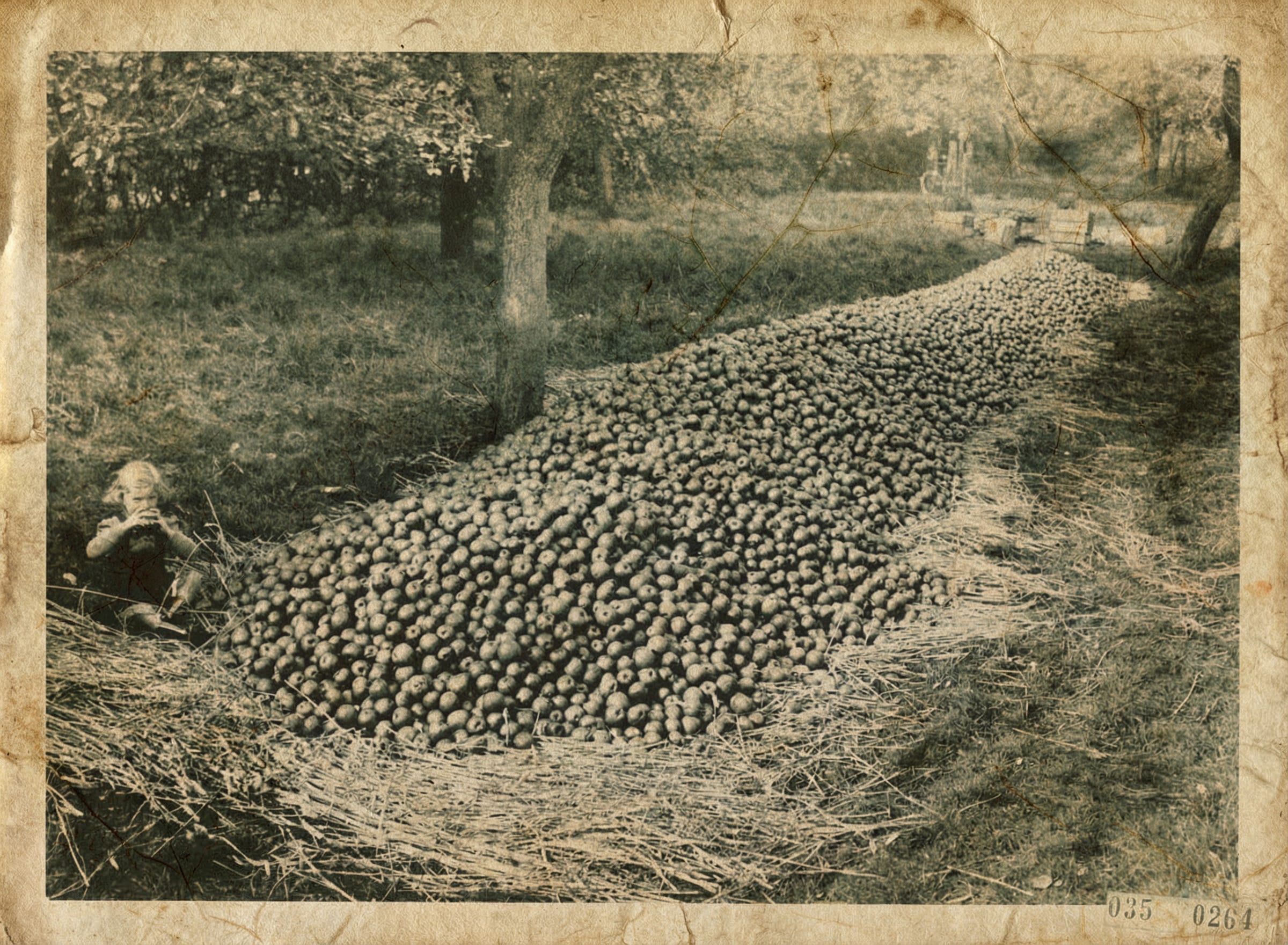
We can’t help ourselves from tinkering, modifying, and “improving” upon everything we do. The apple is a victim of that urge for optimization, too.
Through intensive breeding and selecting, we have created hyper-productive varieties. All of those perfect apples look perfectly uniform and perfectly blemish-free. And: they taste of nothing.
But the problem runs deeper than taste. Already in 1954, Scott Nearing wrote that “Phenyl mercury compounds are used quite extensively on fruit and vegetable crops as fungicides. Investigation of these compounds shows that they accumulate in the kidney and are very poisonous.”
We don’t use DDT anymore, this is true. But instead of learning from the past, we have simply replaced it with a mix of other pesticides. Research from the Pesticide Action Network Europe shows that conventional apples are sprayed on average around 30 times a year. The EU’s most toxic pesticide category contaminates 71% of samples. Neurotoxic pesticides were found on 36%. The authors recommend that parents give priority to organic apples — and peel them if they are not.
The knobbled, russeted, slightly asymmetric old variety from an untreated orchard tree is closer to what an apple actually is. Full of taste. Every single one a unique entity.
Patch 4 | The Old Orchard
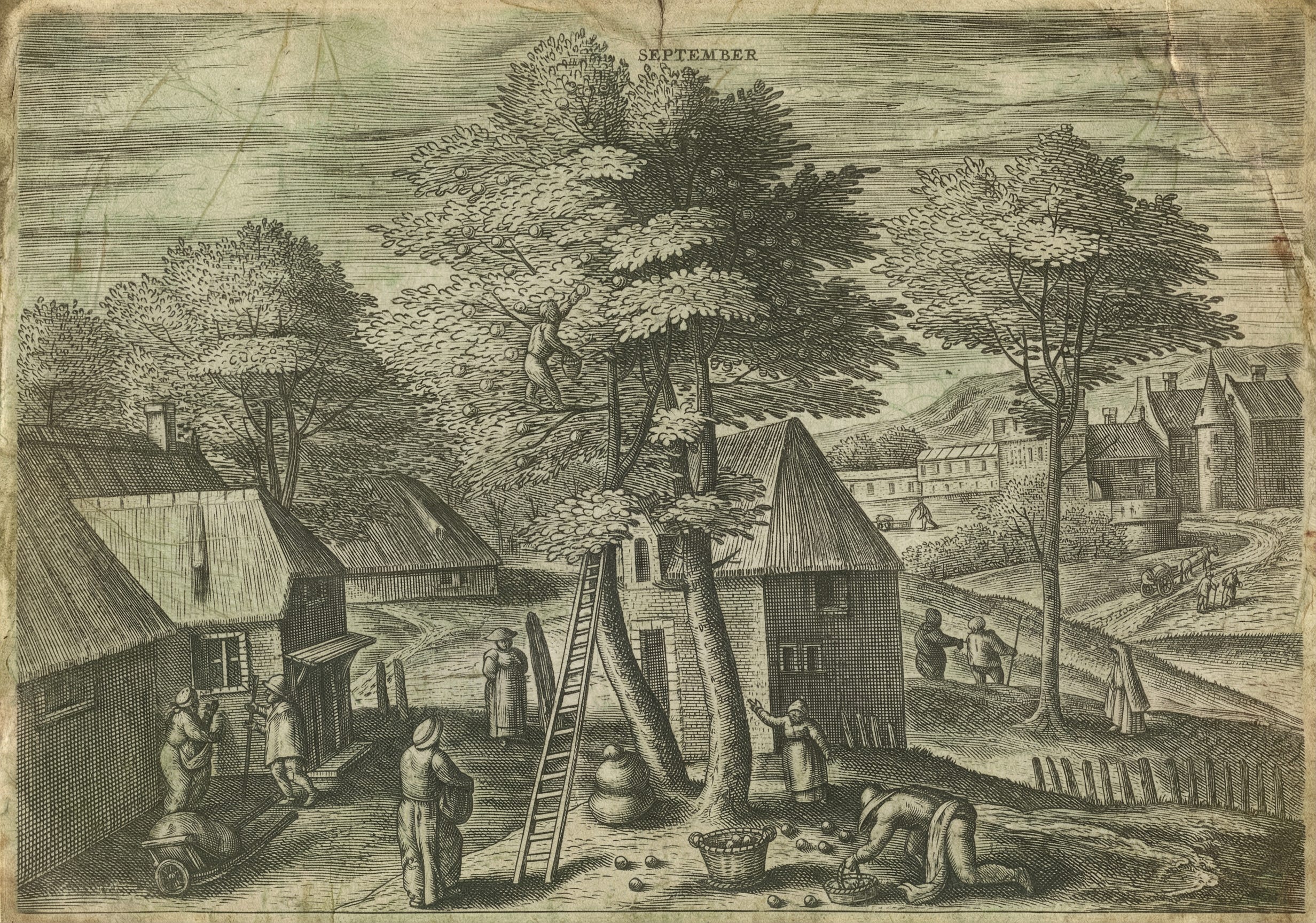
That taste of a ripe apple, straight from that heritage tree, full of fresh sugars. Nothing beats it. But there are more reasons why I treat my little orchard like one from the old world.
I live in a border area in Belgium, between two regions called Haspengouw en Hageland. Haspengouw is known for its apples, and it has a large history of orchards.
In fact, there are hundreds of old apple varieties. These old varieties all have their own characteristics, tastes and growing habits.
Apples were divided strictly by their utility: eating, cooking, keeping, or pressing.
Some examples:
One of the most famous old varieties from the regions is the Keuleman: Around 1900, this was the undisputed star of the region, making up roughly 75% of all standard apple trees. It was an incredible “keeper.” Our ancestors actually stored them in underground pits (”Keule” comes from the word “kuil,” which means pit), much like beets or potatoes, and shipped them by the wagonload to the industrializing German Ruhr region.
Or take the Rabau (Oude Grijskens) as another example. This was often called the apple of the common folk. It was harvested green and hard, stored in the attic under newspaper, and only became sweet and yellow enough to eat by February.
And yes, gravity was part of the old cycle, too. Whatever fruit fell to the ground, got bruised, or didn’t meet the standard for fresh eating or export was never wasted. It was either eaten by the pigs foraging beneath the canopy or it became the raw material for the local stroopfabrieken (syrup factories).
It was a system with no concept of waste, only cascading resources.
These old apple varieties become a symbol: the singular fruit as a carrier of history, place, genetics. Variety and diversity (and not uniformity and quantity) as a true incarnation of beauty and resilience.
Patch 5 | The Vertical Ecotone
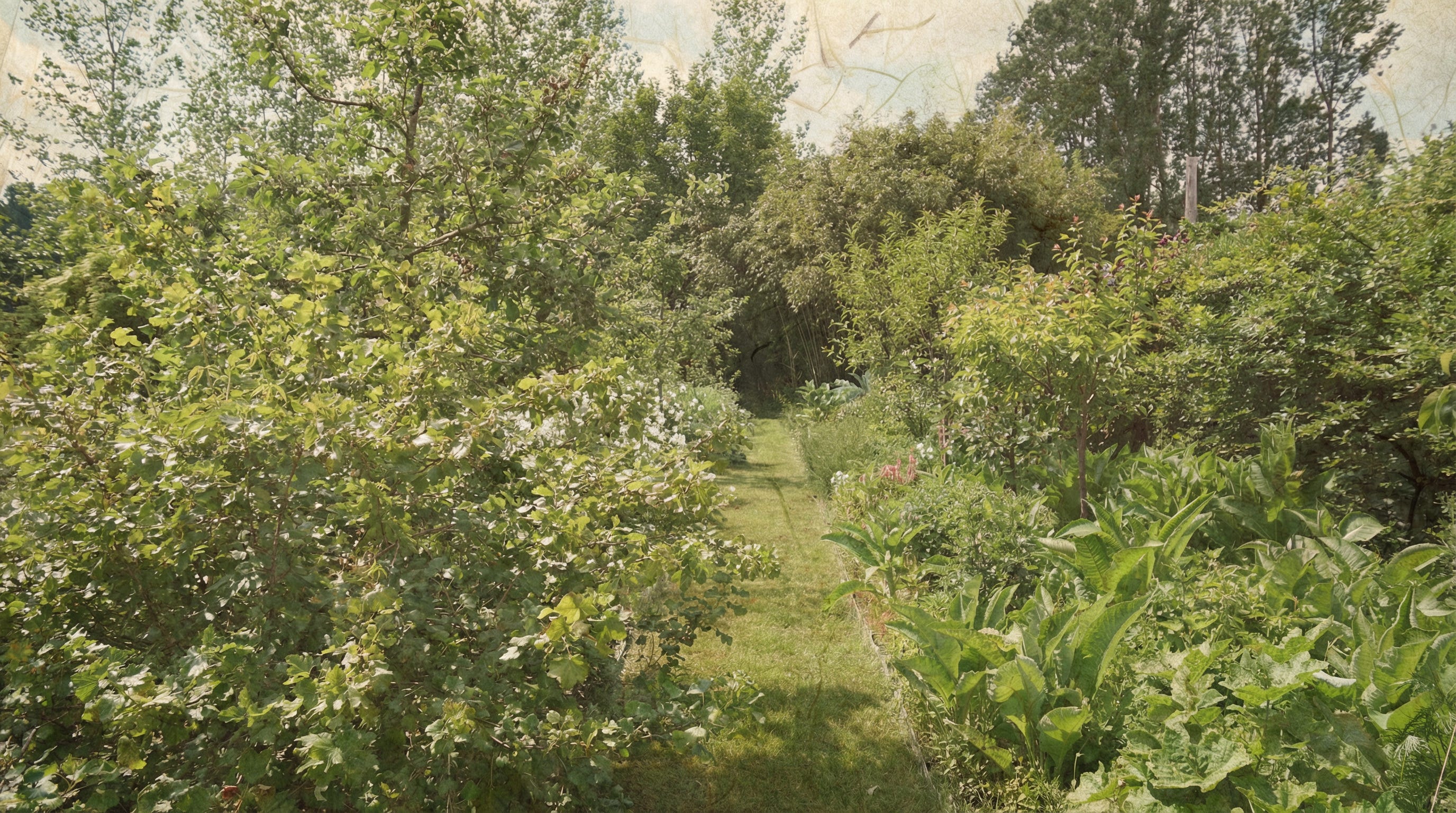
A traditional high-stem orchard is an intriguing example of how our ancestors designed layered and resilient systems without naming them as such.
You have the upper canopy capturing sunlight and producing fruit, while traditionally the ground layer remains open for grazing sheep or cattle.
It is a deliberate overlap; an edge habitat where pasture meets woodland. This creates a multi-dimensional space, both layered in space and time, that supports immense biodiversity, from the fungal networks in the soil up to the wild pollinators in the blossoms.
We can design our own little garden patches with the same intent. Often there is only space for one tree. But we can leverage the three-dimensional space to add functions to that apple tree: a guild!
Under the drip line, we can plant bulbs like daffodils, that catch the water that slides from the crown and stop the grasses from creeping in. Add aromatic herbs like mint or chives to the mix to deter pests. At the same time we want to lure beneficial pollinators. We can do this by adding yarrow, majoram, and fennel.
Comfrey is a perfect dynamic accumulator. We periodically slash the leaves and leave them to rot as mulch, covering and feeding the ground with what it once drew up.
Around the edges, small shrubs or berry bushes fill the vertical space, adding shade, habitat, and fruit of their own.
The apple guild becomes a little system on its own. This simple constellation (the apple and its guild), is a living demonstration of the edge effect: diversity, overlap, and mutual support. It’s a reminder that productivity comes not from the number of parts, but from the quality of their relationships.
Patch 6 | The Apple and the Mechanism
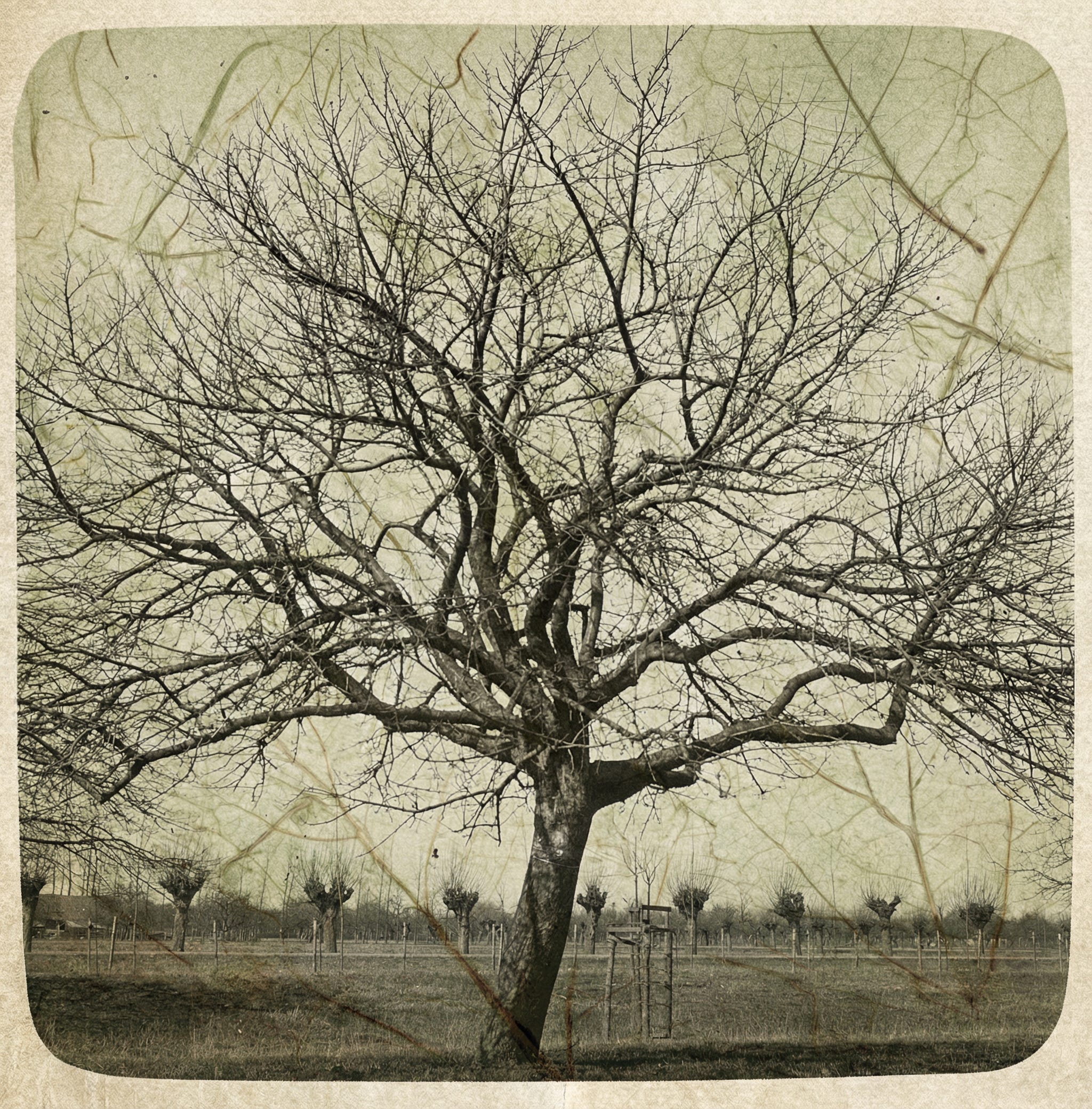
Those few overripe apples still dangling from the barren branches of the March orchard. The refusal to surrender to the pull of gravity.
Legend has it that in the year 1666, Sir Isaac Newton discovered the law of gravity when he watched an apple fall from a tree. However, what he discovered was more than gravity alone.
In a massive leap of intuition, Newton reasoned that the exact same invisible force pulling the falling apple to the ground was the power holding the moon in its orbit around the Earth, and the planets in their orbits around the sun.
This single observation birthed the mechanistic worldview: proof that the same laws of motion applied both on earth and in the vastness of space. The universe, as predictable as a clock. Composed of separate parts, governed by simple forces, devoid of inherent purpose or soul.
It is a seductive idea. And it worked. Spectacularly, for a while.
We know how this plays out in the orchard. Thirty pesticide sprays a year. Uniform varieties bred for shelf life, not taste. The knobbled, russeted apple replaced with tasteless, watery alternatives.
But science is now circling back toward something the old orchardist always knew: there is no such thing as a final destination in nature. No equilibrium. No fixed orbit of living things. Complexity science, systems thinking, even artificial intelligence; all are converging on the same uncomfortable truth. There is only change, relationships, and constant adaptation.
The orchard was never a mechanism. It was always a guild.
In the Archive
Other Patchworks:
The Patchwork Issue 1: Bocage: On ghost hedgerows, the vernacular, and planting the seeds for a digital garden.
Other sources:
If you want to read more on the ecology of orchards, I highly recommend Orchard: A Year in England’s Eden by Benedict Macdonald and Nicholas Gates
Read more on the apple guild in Toby Hemenway’s Gaia’s Garden.
The idea of Newton’s Equilibrium as opposed to Complex Adaptive Systems: Investing: The Last Liberal Art by Robert G. Hagstrom.
A Note on the Commons I am keeping The Perennial Workshop open to everyone because I believe we all need these tools to rethink our thinking. If these writings offer you insight and value, consider becoming a paid subscriber to support the workshop.
Lovely, thanks for sharing your thoughts again, Micha 🙏🏼
Like you, as much as I appreciate the nuggets of wisdom within Fukuoka’s teachings, pruning is one activity I thoroughly enjoy and don’t wish to give up… 😬
Your underplanted orchard looks fantastic, by the way!